

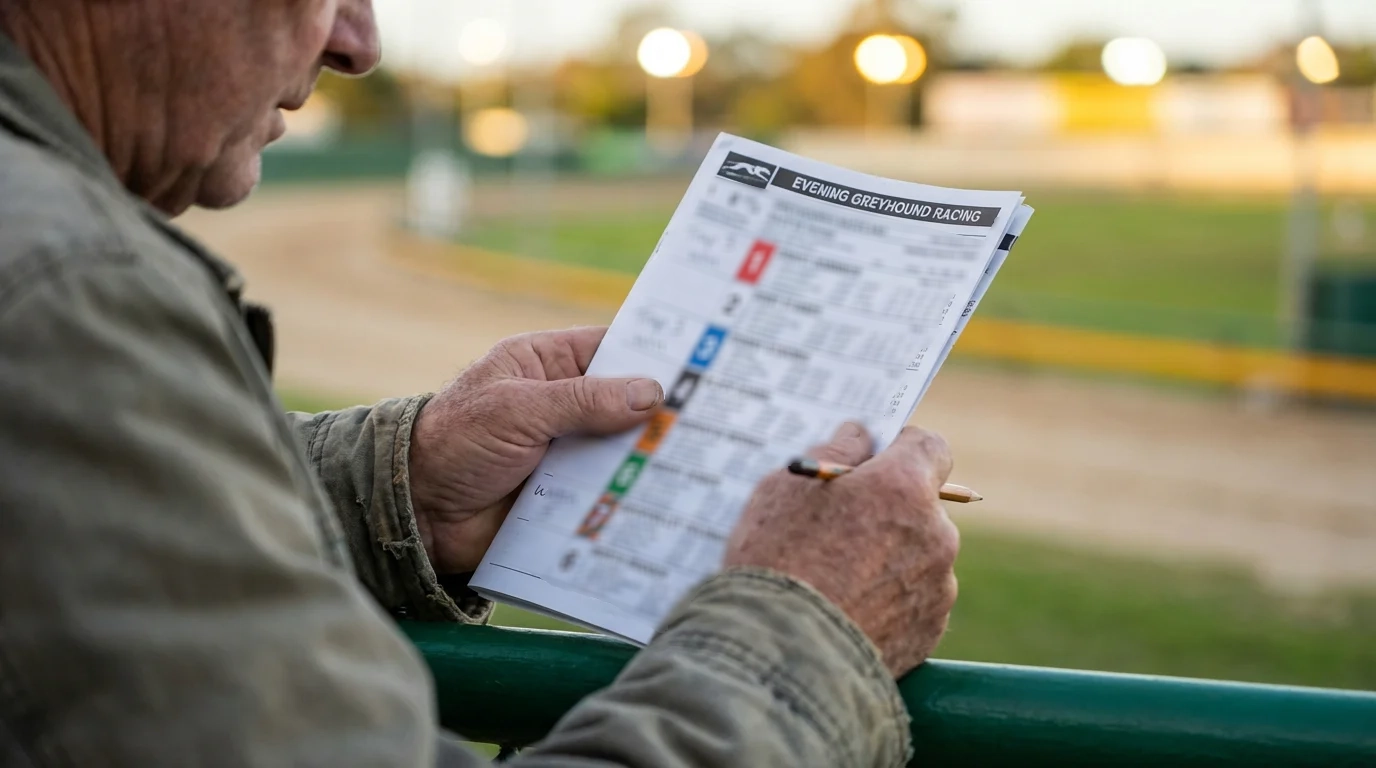
- The Race Card Isn’t Decoration — It’s Your Edge
- Anatomy of a Doncaster Greyhound Race Card
- Running Comments and What They Reveal
- Sectional Times and How to Compare Them
- Trap Number, Weight, and Runner Status
- Reading Trainer and Kennel Information
- Putting It Together: A 5-Minute Form Read
- Beyond the Card: When Form Lies
The Race Card Isn’t Decoration — It’s Your Edge
A Doncaster race card packs more actionable data into six lines than most pundits manage in a paragraph. That’s not an exaggeration — it’s the reality of how greyhound form is presented, and most people walk straight past it.
Watch any BAGS meeting at Meadow Court Stadium and you’ll see the same split in the crowd. One group scans the odds board, picks a trap number or a name they fancy, and hopes for the best. The other group has already spent five minutes with the race card and knows which dog has early pace from trap two, which one got crowded at the third bend last Tuesday, and which trainer hasn’t had a winner in nine days. The second group doesn’t always win — greyhound racing is too volatile for that — but over a month of Doncaster meetings, they lose less and find value more often.
The race card is where that advantage starts. It contains the dog’s recent finishing positions, its running style, its weight, the trap it’s been drawn in, its sectional times, its trainer’s current form, and often a compressed running comment from its last few outings. Each of those data points, on its own, tells you something useful. Taken together, they paint a picture of how a dog is likely to run in the next race — and whether the market has priced it correctly.
This guide breaks down every element on a Doncaster greyhound race card, explains what each one means in practical terms, and shows you how to read the whole thing in under five minutes. No jargon left unexplained, no data point skipped over. By the end, you’ll look at a race card the way a mechanic looks at a dashboard — not as decoration, but as a diagnostic tool.
Anatomy of a Doncaster Greyhound Race Card
Every race card follows the same architecture — once you see the pattern, you can’t unsee it. Whether you’re reading the card on the Racing Post website, through a Betfair race view, or on a printed sheet handed out at Meadow Court, the core information is always there. The layout shifts slightly between platforms, but the data doesn’t.
At the top of any race entry, you’ll find the race header: the time, the distance, the grade, and sometimes the race name if it’s a feature event. The distance and grade together tell you the baseline. A 483m A4 race is a mid-table standard distance event — that immediately sets your expectations for the quality of dog, the likely winning time, and the competitiveness of the field. A 275m D2 sprint is a different beast entirely: faster, more trap-dependent, more chaotic.
Below the header sit six rows, one per trap. Each row is a compressed dossier on a single greyhound. Reading left to right on a typical Racing Post card, you’ll see the trap number and colour, the dog’s name, the trainer’s name, the dog’s form figures from its most recent races, its best time at the race distance, its current weight, and in many cases an abbreviated running comment from its last outing. Betfair cards add Betfair Starting Price history and exchange market data, which is useful for spotting how the market values each runner relative to its form.
The trap number corresponds to the starting box position — trap one on the inside rail, trap six on the outside. Each trap is colour-coded: red for one, blue for two, white for three, black for four, orange for five, and striped black-and-white for six. These colours appear on the dog’s racing jacket and on the card itself, making it easier to follow a dog during the race and to cross-reference its trap history in previous outings.
Trainer information sits next to or beneath the dog’s name. This is more than a label. Trainers at Doncaster run multiple dogs across meetings, and their current strike rate — the percentage of runners producing wins or places over the last fourteen or twenty-eight days — is a form indicator in its own right. A kennel in form tends to have several dogs running well simultaneously. A kennel in a slump drags individual dog form down with it.
Weight is listed in kilograms, usually to one decimal place. Dogs at Doncaster typically race between 26kg and 36kg depending on breed line and build, and the figure on the card is the weigh-in from the day of the race. Weight changes between races matter — a drop of half a kilo or more can indicate a dog that’s been trialled hard or is slightly off condition, while a steady weight across several outings suggests a dog in stable training rhythm.
The best time column shows the dog’s fastest recorded time at the listed distance, usually at Doncaster specifically. This is a reference point, not a prediction. A dog with a best of 29.45 over 483m has demonstrated that level of ability at least once, but whether it reproduces it depends on trap draw, grade, going, and how cleanly it runs.
Form Figures: The Dog’s Recent Resume
Form figures are the first thing experienced punters look at, and for good reason. They compress a dog’s recent race history into a string of numbers that tells you what it’s been doing and whether it’s trending in the right direction.
A typical form line reads something like 1-3-2-5-1. Each number is a finishing position from a recent race, with the most recent result on the right. That sequence reads: won, then third, then second, then fifth, then won again. That’s a dog with ability — two wins in five runs — but also inconsistency. The fifth-place finish stands out. Was it a bad trap draw? A bump at the first bend? A stronger grade? The form figure alone doesn’t answer that, but it tells you where to look next.
Consistency matters more than brilliance in greyhound form. A dog showing 2-2-3-2-1 is arguably more attractive than one showing 1-6-1-5-1, even though the second dog has more wins. The first dog is placing almost every time, which means it’s running cleanly and competing at its grade level. The second dog is either brilliant or nowhere — it might be a front-runner that fades badly when it doesn’t lead, or a dog that suffers in traffic and only wins from a clear run.
The number of form figures displayed varies by source. Racing Post typically shows the last six runs. Betfair may show more. What matters is reading the sequence as a narrative. Look for improvement trends: a dog going 5-4-3-2 is clearly improving and may win next time out, especially if it’s staying at the same grade. Look for decline: 1-2-3-4 suggests a dog being found out at its current level, possibly about to be re-graded. And look for interruptions — a letter in place of a number, like F for fell or T for a trial, tells you something happened that broke the dog’s racing rhythm.
Running Comments and What They Reveal
Comments like “EvPce” or “Crd2” are not random notation — they’re the in-race narrative compressed into code. Every greyhound race at a GBGB-licensed track like Doncaster has an official grader watching the race and recording what happens to each dog. Those observations get condensed into abbreviated running comments that appear on the race card for the dog’s next outing.
Understanding these comments transforms how you read form. A dog that finished fourth might look average on raw figures alone, but if the comment reads “Crd1, RnOn” — crowded at the first bend, ran on — that fourth place conceals a much better performance. The dog was impeded early, lost ground, and still finished close. If it draws a cleaner trap next time, it might win.
Here are the comments you’ll encounter most often on Doncaster cards. “EvPce” means even pace — the dog ran at a consistent speed throughout, neither blazing early nor finishing strongly. It’s a neutral comment, suggesting a dog that runs its own race without drama. “Led” or “Led1” means the dog led from the first bend or led to the first bend — a key indicator of early pace. A dog that repeatedly shows “Led” is a front-runner, and its chances depend heavily on getting a clear run to that first turn.
“SAw” means slow away — the dog was slow out of the traps. This is critical at Doncaster, where the 105-metre run to the first bend means a slow break costs you position fast. A dog with SAw in its last comment and a wide trap draw this time is in trouble before the race starts. But a habitual SAw dog drawn on the inside, at a longer distance where early pace matters less, might overcome it.
“Crd” followed by a number — Crd1, Crd2, Crd3 — means the dog was crowded at the first, second, or third bend. This is a legitimate excuse for a poor finish and the most important comment for form reassessment. Crowding at Doncaster’s first bend is common in 483m races where six dogs funnel into the turn after a relatively short straight. If a dog has been crowded in two consecutive races, the issue might be its running style rather than bad luck — some dogs simply don’t handle traffic.
“Bmp” means bumped — physical contact with another runner during the race, usually at a bend. “RlsStt” means rails to straight — the dog raced on the inside rail into the home straight, which is typically the shortest route and a sign of good racing position. “MsdBrk” means missed break — similar to SAw but more severe, suggesting the dog was significantly slow leaving the box.
The context of the current trap draw matters enormously when reading these comments. A dog whose last comment was “Crd1, RnOn” after racing from trap five is a different proposition if it’s now drawn in trap one. On the rail, it avoids the worst of the first-bend traffic. That crowding excuse might genuinely disappear, and a dog that ran on strongly despite interference could be sitting on a big performance.
Conversely, a dog showing “Led, Wde” — led but ran wide — from trap two is wasteful. It has speed but doesn’t use the rail efficiently. If it’s drawn in trap five or six next time, the wide running might not cost it as much, but it’s still burning energy on a longer route. These details are where race cards stop being information and start becoming analysis.
Sectional Times and How to Compare Them
Sectional times separate the fast starters from the strong finishers — and that distinction decides races. At Doncaster, sectional timing typically records the time to the first bend or the first split point, giving you a measure of early pace that the overall finishing time alone cannot provide.
The logic is straightforward. Two dogs might both run 29.50 over 483m, but if one reached the first bend in 4.10 seconds and the other in 4.35, they ran very different races. The first dog blazed early and held on. The second dog started slowly, found its stride through the middle bends, and finished fast. Neither time is objectively better, but they tell you entirely different things about how each dog will perform depending on trap draw, field composition, and pace scenario.
When you’re comparing sectionals across a race field, line up the first-bend times for all six dogs. The dog with the fastest sectional is your likely leader to the first turn. If that dog is drawn in traps one or two at Doncaster, it has a strong positional advantage — fast early and on the rail means it controls the race from the front. If the fastest sectional belongs to a dog in trap five or six, the situation is messier. That dog has speed but needs to cross the field to find the rail, and in the process it might cause — or suffer — crowding.
Sectionals also reveal hidden form. A dog whose overall time was slow but whose first-split was the fastest in the field probably encountered trouble after the opening bend. Check the running comment — if it reads “Led1, Crd2” or similar, you’ve found a dog that was in front and got interfered with. Its sectional tells the true story: this is a fast dog that had a bad race, not a slow dog.
Doncaster’s 105-metre run to the first bend makes sectional comparison particularly useful. That distance is long enough for genuine speed differences to show, unlike tighter tracks where the first bend arrives before dogs have fully accelerated. At tracks with a shorter run-up, sectionals can be misleading because they’re partly a function of trap draw rather than pure early pace. At Doncaster, the extra run gives each dog time to show what it has, making the sectional a more honest data point.
One caution: sectional times are affected by going conditions just like overall times. A fast track produces faster sectionals across the board, so always compare sectionals within the same meeting or same conditions rather than across different race days. A 4.15 first split on a fast night might be equivalent to a 4.25 on a rain-softened surface.
Trap Number, Weight, and Runner Status
Trap draw gets the headlines, but a 1kg weight shift can tell you more. Both data points sit on the race card, and both deserve attention — though for different reasons.
The trap number tells you where the dog starts: one on the inside rail through to six on the outside. At Doncaster, trap bias varies by distance. Over the 275m sprint, inside traps — particularly trap one — hold a statistical advantage because the race involves only two bends and the inside line is the shortest route. Over 483m and beyond, the bias softens because the longer run to the first bend and additional bends allow dogs to find position regardless of starting box. That said, certain dogs are designated wide runners, marked with a W on the card, meaning the racing manager considers them better suited to outside traps. Middle runners carry an M designation. These flags aren’t arbitrary — they’re based on how the dog has run previously and where it naturally seeks position during a race.
Weight fluctuations are subtler but just as informative. A greyhound’s racing weight is recorded at every meeting, and the race card shows the current figure alongside, on some platforms, the weight from its last run. A steady weight across four or five outings suggests a dog in routine training condition. A weight gain of half a kilo or more might indicate the dog has been rested or eased up in training. A weight drop of similar magnitude could mean increased training intensity, or it could hint at the dog being slightly off — illness, stress, or a demanding trial schedule.
The key is pattern, not snapshot. A single weight reading means nothing in isolation. But a dog that has gradually lost half a kilo over three races and whose form has simultaneously deteriorated is showing you something the form figures alone might not make obvious. Likewise, a dog coming back at its previous winning weight after a fluctuation is worth noting — it’s physically back where it was when it performed best.
Runner status notes round out this section of the card. “R” means reserve — the dog only runs if another is withdrawn. Reserves are worth tracking because they sometimes get a late call-up and run under-prepared, but occasionally a reserve that’s been trialling well slots in and catches the market cold. A non-runner is marked and removed from the card before the off, which reshuffles trap positions and affects the dynamics of every remaining runner.
Reading Trainer and Kennel Information
Certain kennels run hot for weeks then go cold — trainer form is its own pattern, and ignoring it is leaving data on the table. The race card lists the trainer for every runner, and that name connects to a broader web of information if you know where to look.
Trainer strike rate is the starting point. This is simply the percentage of a trainer’s runners that win over a given period — typically the last fourteen or twenty-eight days. A trainer running at a 25% strike rate over the last fortnight is having a strong spell. If that trainer has two or three runners on a Doncaster card, the probability of at least one of them being competitive is higher than their individual form might suggest. The kennel is in rhythm: dogs are fit, trialling well, and getting the right preparation.
The reverse is also true. A trainer whose strike rate has dropped to single digits over the last month may have an issue across the kennel — illness passing between dogs, a change in training surface or routine, or simply a run of bad draws. Individual dogs from a cold kennel can still win, but the pattern should make you cautious rather than confident.
At Doncaster, certain trainers regularly supply dogs for the standard BAGS meetings. Over time, you’ll notice which kennels dominate particular grades or distances. Some trainers specialise in sprinters and consistently produce fast 275m dogs. Others build stayers and target the 661m and 705m races. Knowing these tendencies helps when assessing a dog’s chances — a sprint specialist from a kennel known for early-pace dogs is a different proposition in a 275m race than a stayer being dropped to a shorter distance by a trainer who rarely runs sprints.
Trainer changes are another signal the card provides. When a dog moves from one kennel to another — marked on some platforms or inferred from a change in trainer name between consecutive runs — the form reset is significant. The dog may improve dramatically under new training methods, or it may take several races to adjust. Either way, the previous form figures become less reliable as a predictor, because the training environment has changed. Early runs for a new trainer are low-information events, and betting on them is closer to speculation than analysis.
One practical habit worth developing: before a Doncaster meeting, check the overall trainer statistics for the card. If one kennel has five runners across the evening and is running at a 20%+ strike rate, at least one of those dogs is statistically likely to be competitive. It won’t tell you which one, but it narrows the field of runners worth studying closely.
Putting It Together: A 5-Minute Form Read
Here’s the process: open the card, ignore the noise, read these five things, decide. That’s the discipline. Five minutes per race is enough to make an informed judgement at Doncaster, provided you’re reading the right data in the right order.
Start with the grade. The grade tells you the standard of the race and sets your expectations for everything else. An A3 race at 483m features dogs running around 29.20–29.60 in normal conditions. An A7 race features dogs in the 30.00–30.40 range. Knowing the grade means you can immediately spot outliers — a dog whose best time is half a second faster than anything else in the field is either well in at the weights or has a reason for dropping to this level.
Next, scan the form figures for all six dogs. You’re looking for two things: consistency and trajectory. Which dogs are placing regularly? Which dogs are improving? A dog with 3-2-1 in its last three runs at the same grade is the definition of a progressive profile. A dog with 1-4-6 is going the wrong way. Spend thirty seconds on this and you’ll already have a shortlist of two or three contenders.
Third, check the trap draw against each dog’s running style. Pull up the running comments from the last couple of outings. Is the dog in trap one a confirmed railer that led last time? Good draw. Is the dog in trap six a wide runner with early pace? Reasonable draw. Is the dog in trap three a slow beginner that got crowded at the first bend last week? Bad draw — trap three is the middle of the pack, and a slow breaker from the middle gets squeezed by dogs on either side.
Fourth, compare sectional times. Line up the first-split times for the field and identify the likely pace. If two dogs have fast sectionals and they’re drawn next to each other, they might clash for the lead and open the door for a closer. If only one dog has a clearly superior sectional and it’s drawn inside, it’s probably leading to the first bend unchallenged — and at Doncaster, the dog that leads to the first bend wins more often than not over 275m and 483m.
Fifth, glance at trainer form. This takes fifteen seconds. Which trainers are in form this week? If your shortlisted dog happens to come from a kennel currently running at a high strike rate, that’s a confirming signal. If it’s from a kennel that hasn’t won in three weeks, it’s not a disqualifier, but it should temper your confidence slightly.
That’s the process. Grade, form, trap-and-style, sectionals, trainer. Five data points, five minutes, one decision. You won’t get every race right — nobody does in greyhound racing — but you’ll approach every race with a structured framework instead of a gut feeling. Over a month of Doncaster meetings, that structure compounds into a measurable edge.
One final note on discipline: the process should also tell you when not to bet. If a race is genuinely open — four dogs with similar form, no clear pace angle, a mixed trap draw — the honest read is that there’s no edge. Skipping a race isn’t a failure of analysis. It’s the analysis working correctly.
Beyond the Card: When Form Lies
Form is the best tool in the punter’s kit — but even the best tools break against reality. There are situations where every data point on the race card is technically accurate and yet collectively misleading, and recognising these moments is as important as knowing how to read the card in the first place.
The most common scenario is the track switcher. A dog arriving at Doncaster from another UK track — Romford, Nottingham, Sheffield — carries form from a different circuit with different dimensions, a different surface condition, and a different run to the first bend. Its form figures might read 1-1-2, which looks outstanding, but those results were achieved on a 350-metre circumference track with a 67-metre run-up. Doncaster’s wider oval and longer 105-metre run change the race dynamics entirely. The dog’s early pace might be less dominant here, or its bend-running style might not suit the wider turns. Track-switch form is provisional until proven at the new venue, and the card won’t flag that distinction for you.
Returning from injury is another form trap. A dog that hasn’t raced for three weeks or more may show strong form from before the layoff, but that form is stale. The card might display a trial result — marked with a T — in the form line, which tells you the dog has been back on the track, but trials are ungraded and uncontested. They show fitness, not race sharpness. A dog’s first run back from injury is typically below its best, even if the trial time looked promising. Backing these dogs at short odds because their pre-injury form was strong is one of the most reliable ways to lose money in greyhound racing.
Grade changes add another layer of uncertainty. A dog dropping from A3 to A5 looks like an opportunity — it’s facing weaker opposition. But the drop happened for a reason. Maybe the dog lost three consecutive races because it’s genuinely slower now, not because it was unlucky. Maybe it’s older, carrying a niggle, or has lost the early pace that made it competitive at a higher grade. The grade drop creates the appearance of value without guaranteeing actual value. The card shows you the grade; it doesn’t explain the trajectory behind it.
First-time distance runners are similarly opaque. A dog stepping up from 483m to 661m has no stayer form to assess. Its sprint sectionals and standard-distance times might suggest it has the stamina, but staying is a different skill — it requires a dog to maintain pace through extra bends, to handle a longer race mentally as much as physically. The card gives you nothing concrete to work with here, just inference.
None of this means form is unreliable. It means form is incomplete. The race card gives you the best available evidence, structured in a way that rewards careful reading. But the punter who treats that evidence as the whole truth, rather than the best available approximation, is the punter who gets caught when reality diverges from the data. Read the card thoroughly, apply the five-step process, and then hold your conclusions lightly enough to adjust when the track delivers something the numbers didn’t predict. That balance — between rigour and humility — is where long-term profit at Doncaster actually lives.
