

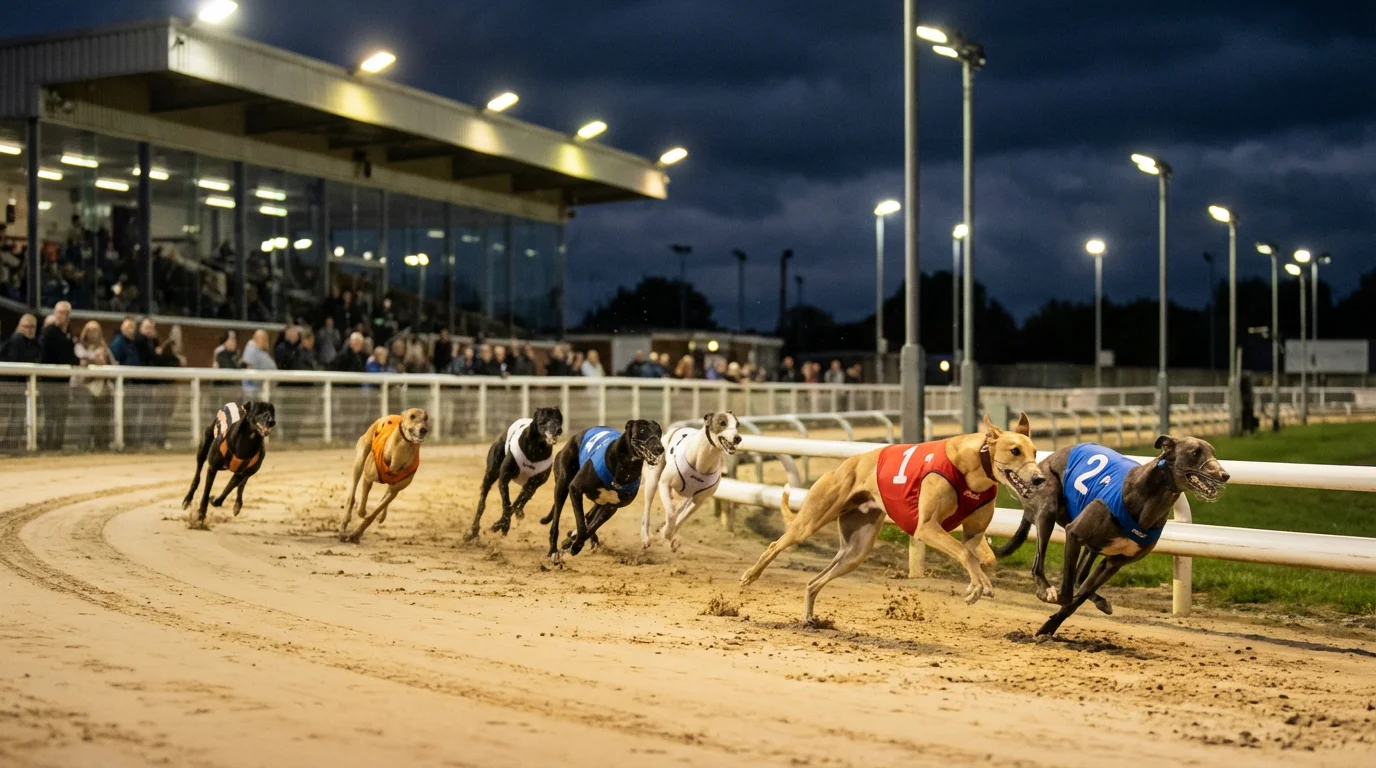
Doncaster Greyhound Results: The Complete Punter's Handbook
Doncaster's six-trap starting boxes slam open five days a week, and every result tells a story if you know how to read it. Meadow Court Stadium, tucked into the South Yorkshire flatlands at Stainforth, runs more graded meetings than most punters realise. The sand track sees action on Mondays, Tuesdays, Wednesdays, Saturdays, and Sundays, producing hundreds of individual race results each month. That volume is the point. Where casual spectators see a parade of dogs and dividends, informed bettors see a dataset that compounds over time, revealing trap biases, trainer patterns, grade movements, and timing trends that the starting prices never fully absorb.
This guide is not a glossy introduction to greyhound racing. It is a working manual built around one specific track, written for the punter who wants to extract real information from Doncaster greyhound results rather than scrolling through numbers and hoping for the best. Every section connects results data to a practical decision: which columns to prioritise, which form figures matter, when a grade drop signals genuine value, and how to construct a basic pre-bet process that actually improves your strike rate.
The approach here is technical but readable. If you already know what a forecast dividend is, you will still find something useful in the trap analysis or the staking angles. If you are newer to the dogs, the sections on reading results and decoding form will give you a framework that works at Doncaster specifically, not some generic advice transplanted from a horse racing textbook. The track dimensions, the sand surface, the 105-metre run to the first bend — these details shape outcomes in ways that only become visible when you pay attention.
Doncaster at a Glance
Track circumference: 438 metres. Race distances: 275m, 483m, 661m, 705m. Surface: sand. Hare: outside Swaffham. Meeting days: Monday, Tuesday, Wednesday, Saturday (double-header AM and PM), Sunday. Races per card: 12 (14 on Saturdays). Grandstand capacity: approximately 1,500. Location: Meadow Court Stadium, Station Road, Stainforth, DN7 5HS. Licensed by the Greyhound Board of Great Britain.
Interactive Tool
Weekly Race Volume Checker, and Combination Tricast Profit
Test whether Saturday really makes up "roughly a quarter" of the week, and calculate exact tricast profit for any dividend.
Saturday's Share of the Week
-
Weekday Total
-
Saturday Total
-
Week Total
-
What this guide leaves ambiguous: "Races per card: 12 (14 on Saturdays)... Saturday runs a double-header... Saturdays alone generate roughly a quarter of the week's total races." If "14 on Saturdays" means 14 per session (AM and PM), Saturday actually supplies 36.8% of the week — not a quarter. Only if "14" is the day's combined total does the maths land near 25%.
Exact Profit
-
-
Dividend
-
Outlay
-
Return on Outlay
-
What this guide gives one figure for and leaves the other vague: "If the tricast dividend is £120, your return is £120 against a £6 outlay — a profit of £114. If the dividend is £25, your return is £25 against £6, which is still profitable but less dramatic." The exact profit on that second example is never stated — it is £19.
Whether you check Doncaster greyhound results on the official stadium site, through Timeform, or via the GBGB results service, the raw data is the same. The difference between punters who profit and punters who donate is what happens between reading the result and placing the next bet. That gap — between data and decision — is what this guide is designed to close.
Doncaster Track Profile: Dimensions That Shape Results
Every greyhound track in Britain has a personality defined by its physical dimensions, and Doncaster's personality is written into 438 metres of oval sand. The circumference is mid-range by UK standards — larger than the tight northern circuits like Sunderland (378m) but smaller than the wide southern ovals like Towcester's 420m layout. That middle ground matters because it produces a track that is neither a pure speed ring nor a galloping theatre. Dogs need early pace to secure position, but the bends are open enough to let a strong finisher recover from a slow break.
The run to the first bend is where Doncaster distinguishes itself. At 105 metres from the traps, it is one of the longer approaches in GBGB-licensed racing. That distance gives the field time to separate before the first turn, which means less crowding, fewer checked runs, and a slightly fairer representation of each dog's ability in the final result. Compare that to a track like Romford, where a shorter run-up compresses the field and amplifies the advantage of inside trap draws. At Doncaster, the 105-metre stretch does not eliminate trap bias — it tempers it, which is a distinction that shows up clearly in the long-term statistics.
The surface is sand, as with all modern GBGB tracks, and Meadow Court runs an outside Swaffham hare. The sand drains well enough that meetings rarely get cancelled for weather, though track conditions do vary. A rain-soaked card will produce slower times across the board, and dogs that rely on a fast early sectional can lose their edge when the going turns holding. Punters who ignore track conditions when comparing times across different meetings are effectively comparing different events and drawing the wrong conclusions.
Circumference
438 metres
Run to First Bend
105 metres
Race Distances
275m, 483m, 661m, 705m
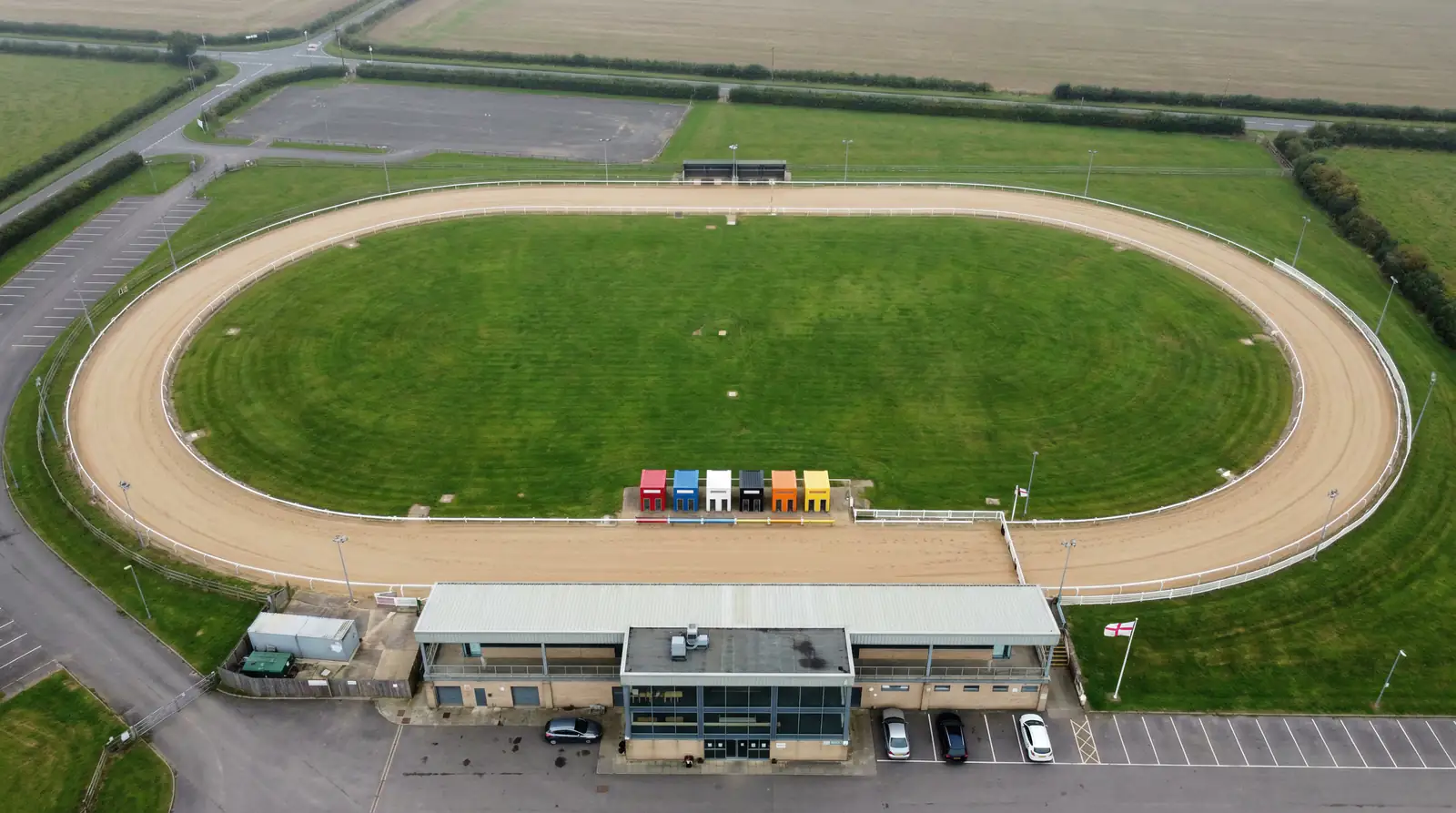
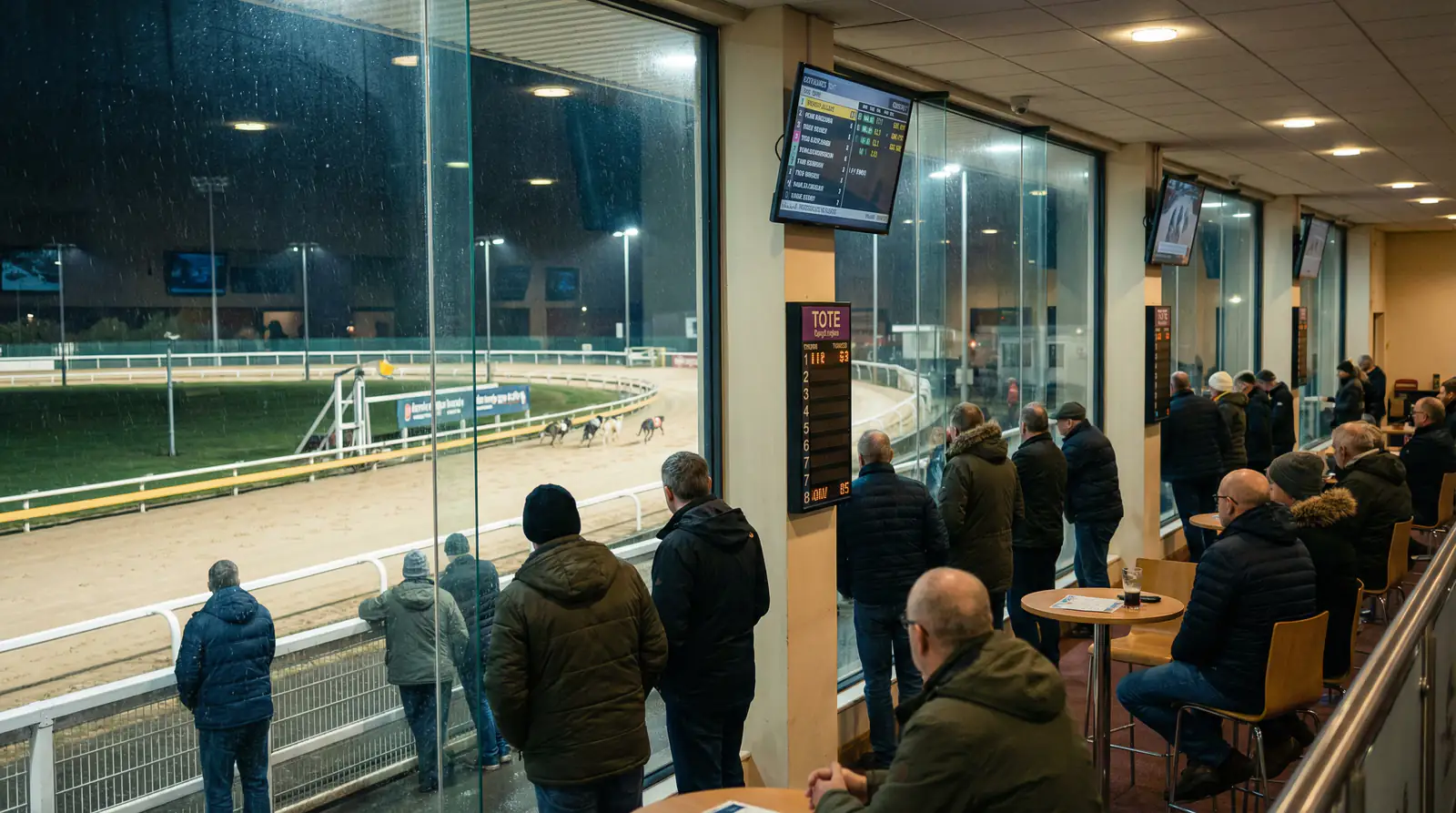
The grandstand seats roughly 1,500 and overlooks the home straight, giving on-track punters a clear view of the finish — and, more importantly, of the run to the first bend. If you are watching live rather than on a screen, that vantage point is worth using. You can see which dogs break cleanly, which get crowded, and which recover positions that the bare result might not fully explain. The track layout rewards observation as much as it rewards data.
Race Distances at Doncaster: 275m to 705m
Doncaster races over four distances, each producing a fundamentally different type of contest. Understanding which distance you are looking at before you study the form is not optional — it is the first filter that separates relevant data from noise.
275 metres is the sprint. Two bends, a short burst of acceleration, and very little room for error. Races at this distance are typically over in under 17 seconds, and the dog that breaks fastest from the traps almost always wins. Trap draw matters more here than at any other distance because the field has no time to reorganise. Early pace is everything. Form figures from 275m races should be read with that in mind: a dog that finishes third after a slow break may have more raw speed than its position suggests. The 275m is also where you will see the most volatile starting prices, because sprint outcomes are harder for the market to price accurately.
483 metres is the standard distance and the workhorse of the Doncaster card. The majority of graded races happen here, which means the majority of results data comes from 483m contests. Four bends, a balance of early pace and sustained running, and enough distance for a strong finisher to make up ground after a poor start. This is the distance where form is most reliable, where trap statistics have the largest sample sizes, and where grade comparisons are most meaningful. If you are going to specialise in one distance at Doncaster, this is the one.
661 metres is stayers' territory. The extra bends demand stamina, and the race dynamic shifts accordingly. Early speed still matters — you do not want to be trailing by six lengths after the first turn — but the capacity to sustain that speed through six bends separates the genuine stayers from the dogs that simply run fast for a short while and then fade. The Yorkshire St Leger, Doncaster's flagship open competition, is contested over this distance. Dogs with a strong 661m record at Meadow Court tend to be specialists, and their form at shorter distances may not translate.
705 metres is the marathon distance and the rarest on the card. Races here are infrequent enough that the results dataset is thin, which makes statistical analysis less reliable. What the 705m does offer is unpredictability: the longer the race, the more opportunities for positional change, interference, and fatigue-related errors. Outsiders win more often at 705m than at any other distance, which is either an opportunity or a trap, depending on how you manage your staking.
Results tell you what happened — form tells you why.
How to Read Doncaster Greyhound Results
A Doncaster greyhound results page is dense with data, but only three or four columns actually matter for your next bet. The rest is useful context, not decision-making material. Learning to distinguish between the two is the first real skill in results-based betting.
When you pull up results from any Doncaster meeting — whether through the GBGB website, Timeform, or the stadium's own results service — you will see a table for each race listing the finishing order, trap numbers, dog names, finishing distances, winning time, starting prices, and dividend payouts. Each of those columns has a function, but the ones that carry the most weight for future selections are the winning time (adjusted for grade and going), the finishing distances (which reveal how competitive the race was), and the starting price or BSP (which tells you what the market thought before the off).
The mistake most casual punters make is reading results as a narrative — this dog won, that dog lost — rather than as a data point in a larger series. A single result at Doncaster tells you almost nothing useful. Five results at the same distance, from the same trap range, at a similar grade? Now you have a profile. Ten results over two months? You have a trend. The results page is not the story. It is a chapter, and it only makes sense when you read it alongside the chapters that came before.
Winning time is the column that gets the most attention and the most misuse. A fast time means nothing unless you know the grade of the race, the track conditions that evening, and whether the dog led from the front or came through from behind. A 29.50 at 483m in an A3 race on a fast track is a different achievement from a 29.50 in an A7 on rain-softened sand. The time is the same. The context is completely different. Punters who compare raw times without adjusting for these variables are doing arithmetic, not analysis.
Winning time alone tells you nothing — time relative to grade and going tells you everything.
The SP and BSP columns deserve more attention than they typically receive. The starting price reflects the on-course market, while the Betfair Starting Price reflects exchange activity. When there is a significant gap between the two — say, a dog opens at 3/1 SP but closes at 4.5 BSP — it often signals that the on-course money and the exchange money disagree about the dog's chances. That disagreement is information. It does not always point to value, but it flags races where the market was uncertain, which is exactly where an informed punter can find an edge.
Breaking Down the Results Columns
Here is what each column in a typical Doncaster results table gives you, and what it leaves out.
Trap number identifies the starting box (1 through 6). Trap 1 is the inside rail, trap 6 is the widest. The trap number is assigned by the racing manager based on the dog's running style — railers go inside, wide runners go outside. When a dog is drawn in an unfamiliar trap, the result may reflect the draw more than the dog's ability.
Dog name and trainer are self-explanatory, but the trainer column is worth watching over time. Certain kennels go through hot and cold periods at Doncaster, and a trainer with a 30% strike rate over the last fortnight is a different proposition from one running at 8%.
Finishing position and distances show where each dog finished and by how far. Distances in greyhound racing are measured in short heads, heads, necks, and lengths. A dog beaten by a short head was effectively level; a dog beaten by six lengths was never competitive. The distance column tells you whether a race was a genuine contest or a procession, which changes how much weight you should give the winner's time.
Winning time is the clock reading for the winner. At Doncaster's 483m distance, competitive times range from roughly 29.20 to 30.50 depending on grade and conditions. Faster is not always better — what matters is how the time compares to the standard for that grade at that distance on that type of going.
Weight is recorded in kilograms. Weight changes between runs can indicate fitness shifts: a dog that has put on a kilo since its last outing may be carrying condition rather than muscle, while a significant drop could suggest a training regime change or recovery from illness. It is a secondary indicator, but it occasionally flags something the form figures miss.
SP and BSP record the starting price and Betfair Starting Price respectively. The SP is determined by the on-course market; the BSP by exchange activity at the off. Discrepancies between the two are covered in the section above — they are one of the most underused signals in the results table.
Forecast and tricast dividends show the payouts for the first-two and first-three in correct order. These columns are most useful as a proxy for how predictable the race was. A forecast paying 8.50 was a result the market largely expected. A forecast paying 85.00 was a shock, and shocks at Doncaster often correlate with specific conditions: early crowding, a grade change in the field, or a first-time runner at the distance.
Decoding the Form Guide for Doncaster Dogs
Form figures are a compressed biography of a greyhound's recent career — every digit carries weight. A sequence like 1-3-2-5-1 is not just a list of finishing positions. It is a narrative: the dog won, then dropped to third (why?), recovered to second, had a poor run, and bounced back to win. The question marks between those numbers are where the real analysis happens.
At Doncaster, form figures typically display the last six runs, read from left to right with the most recent result on the right. A dog showing 1-1-2-1-1-1 is in devastating form and will be priced accordingly — short odds, little value unless you have reason to believe the market is still underestimating it. A dog showing 5-6-4-3-2-1 is improving rapidly and may still be available at a price that reflects its earlier poor results rather than its current trajectory. Spotting improvement before the market prices it in is one of the most reliable edges available to the diligent form reader.

The form guide also includes running comments from each race. These shorthand codes — EvPce (even pace), Crd (crowded), SAw (slow away), Led (led from the traps), RlsStt (rails to straight), Bmp (bumped) — provide the context that bare finishing positions cannot. A dog that finished fourth after being crowded at the second bend had a different race from a dog that finished fourth after leading for most of the trip and fading. The first has an excuse; the second might be declining. Reading running comments alongside finishing positions turns a flat set of numbers into a three-dimensional picture of each dog's recent racing life.
Wide runner (W) and middle runner (M) designations appear on some form guides and indicate the dog's preferred running line. A wide runner drawn in trap 1 is being asked to rail, which contradicts its natural style. The result of that run should be interpreted with the trap draw in mind, not at face value. Doncaster's 105-metre run to the first bend gives wide runners slightly more room to find their line than tighter tracks do, but a bad draw is still a bad draw.
The grade of each previous race is listed alongside the form figures. This is essential context. A dog that won an A7 race last week and is now entered in an A5 has stepped up two grades — it is facing faster, more competitive opposition. Its previous win is less relevant than you might think. Conversely, a dog dropping from A3 to A5 after a string of mid-field finishes is moving into easier company, and its finishing positions in the tougher grade may actually indicate more ability than they first suggest. Grade-adjusted form reading is the difference between reacting to numbers and interpreting them.
Trap Draw Analysis: Which Boxes Win at Doncaster
Trap one hugs the rail, trap six takes the widest line — but the numbers do not always favour the shortest route. Doncaster's trap draw statistics across different distances reveal patterns that are more nuanced than the conventional wisdom suggests, and understanding those patterns is worth a few percentage points on your long-term strike rate.
At the 275m sprint distance, inside traps do hold a measurable advantage. The short run to the first bend and the tight two-bend layout mean that a dog breaking quickly from trap 1 or trap 2 can establish the rail position early and hold it through to the line. Traps 5 and 6 have to cover more ground on every turn, and in a race that lasts under 17 seconds, there is no time to make that up. If you are serious about sprint betting at Doncaster, the trap draw is not one factor among many — it is the primary factor.
At 483m, the picture shifts. The longer run to the first bend — 105 metres, remember — gives the field more room to sort out. Dogs in middle traps (3 and 4) often perform better than their sprint equivalents because they avoid the scrimmaging on the rail without suffering the extra distance of the wide boxes. Over a large enough sample of 483m races at Doncaster, the win rate differences between traps typically range from 14% to 19%, which is meaningful but not overwhelming. That range is wide enough to influence marginal selections and narrow enough that a strong dog in a weak trap can still win comfortably.
At 661m and 705m, trap bias flattens further. The stayers' distances involve more bends and more opportunities for positional reshuffling, and stamina becomes the dominant factor. A dog with the engine to sustain its pace through six bends will overcome a wide draw more often than a sprinter can overcome the same handicap in a two-bend dash. If you are weighting your selections heavily on trap draw at the longer distances, you are probably overcomplicating the picture.
Worked Example: Reading Trap Win Rates at 483m
Suppose you have recorded the last 200 races at Doncaster over 483m and calculated the following trap win percentages: Trap 1: 19%, Trap 2: 18%, Trap 3: 17%, Trap 4: 16%, Trap 5: 15%, Trap 6: 15%.
A perfectly neutral track would show each trap winning 16.7% of the time (100% divided by 6 traps). Trap 1 at 19% is outperforming by 2.3 percentage points. In odds terms, that shifts the fair price of a trap 1 dog from roughly 5/1 (16.7%) to closer to 9/2 (19%). If the market is offering 6/1 on a trap 1 runner with decent form, the trap statistic alone does not make it a bet — but it does mean you are getting a price that fails to account for a proven track advantage.
Conversely, a trap 6 dog at the same price of 6/1 is being offered at fair value relative to its draw, so you need the form and grade to be substantially in its favour before the bet makes sense.
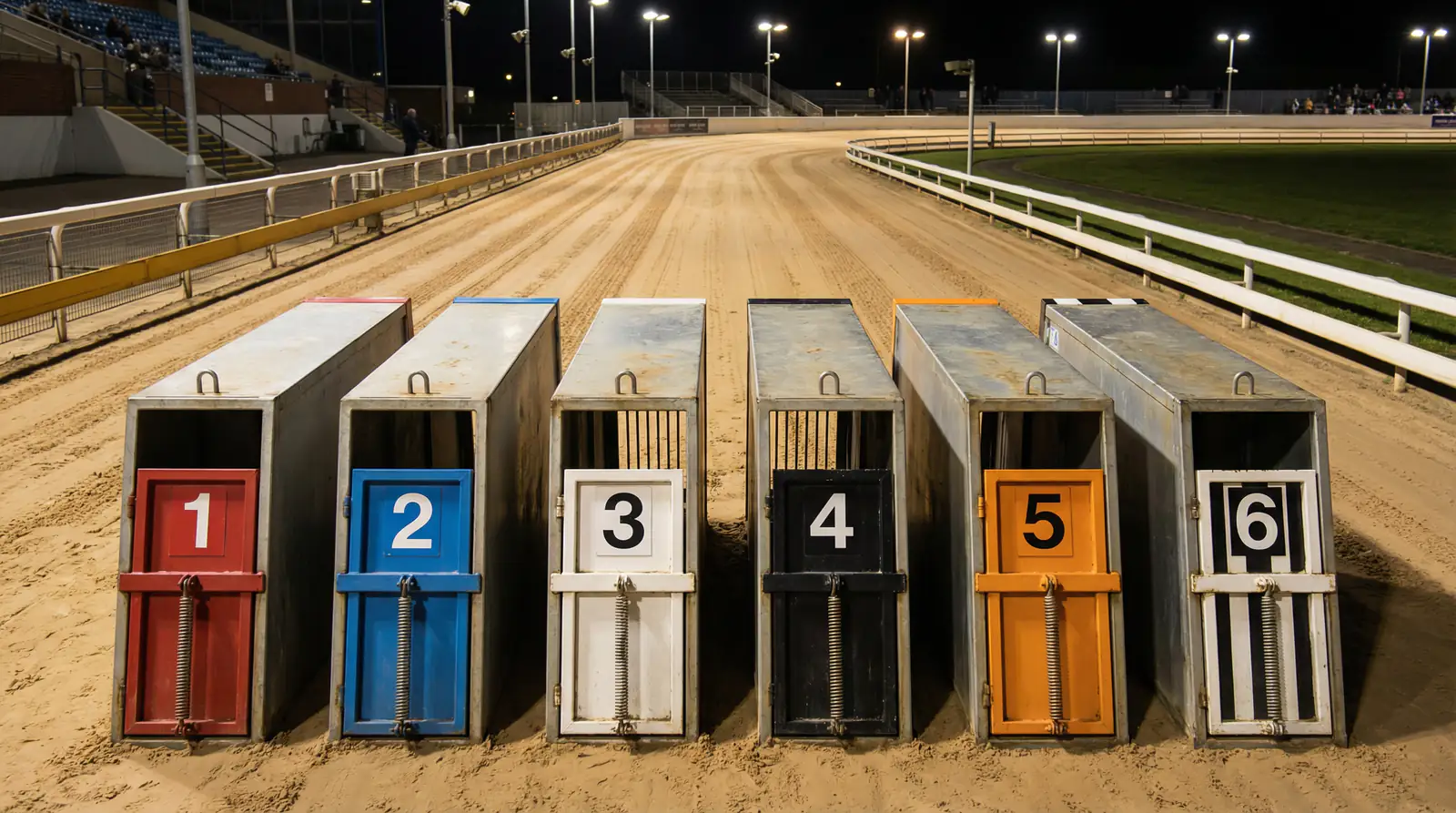
The key with trap statistics is sample size. Fifty races is not enough to draw reliable conclusions — random variation over a short period can easily produce misleading patterns. Two hundred races at a single distance starts to smooth out the noise. Four hundred gives you something you can genuinely lean on. Doncaster runs enough meetings per week that building this dataset does not take as long as it might at a less active track, particularly at the 483m standard distance. Recording and updating your own trap data is one of the highest-return investments a Doncaster regular can make.
Betting Markets on Doncaster Greyhound Races
Win, each-way, forecast, tricast, tote pools — the menu of bets at Doncaster is broader than most punters use. The majority of casual racegoers stick to win singles and the occasional forecast, leaving entire market segments largely unexplored. That is not a criticism. Simplicity is a valid staking strategy. But understanding what is available helps you identify situations where a different bet type offers better expected value than your default selection.
A win bet is the foundation: pick the dog that crosses the line first. At Doncaster, win markets are available through on-course tote betting and through every licensed bookmaker. Prices are expressed as fractional odds (5/2, 3/1, 7/2) or decimal odds (3.50, 4.00, 4.50), depending on the platform. The SP is settled after the race based on the on-course market. The BSP is the exchange-determined price at the off.
A place bet pays if your dog finishes first or second. In greyhound racing, place terms cover the first two positions in a standard six-runner field, which is tighter than the horse racing equivalent. Each-way combines a win bet and a place bet in a single stake — two bets, two units of stake. If your dog wins, you collect the win dividend and the place dividend. If it finishes second, you get the place dividend only. Each-way betting at Doncaster makes most sense when you have a dog you fancy strongly but the win price is short enough that the place insurance justifies the doubled stake.
Example: Each-Way Bet on a Doncaster 483m Race
Selection: Trap 3 to win at 5/1. Stake: £5 each-way (total outlay: £10).
If the dog wins: Win return = £5 x 5/1 = £25 + £5 stake = £30. Place return = £5 x 5/4 (quarter odds) = £6.25 + £5 stake = £11.25. Total return: £41.25. Profit: £31.25.
If the dog finishes second: Place return only = £11.25. Loss on the bet: £10 - £11.25 = +£1.25 profit.
If the dog finishes third or worse: Total loss = £10.
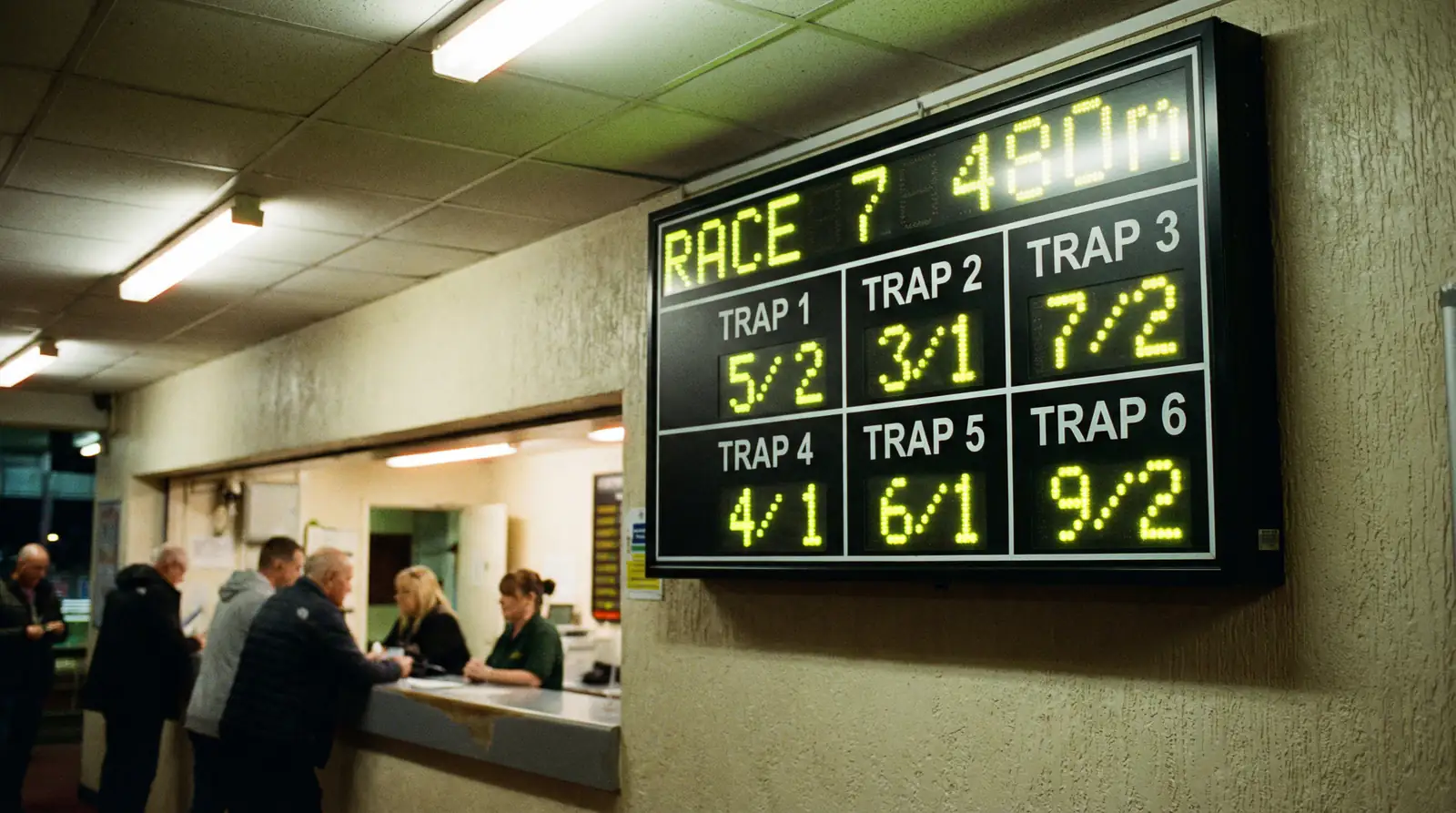
Tote betting operates on a pool system. All stakes on a particular bet type go into a shared pool; after a percentage deduction (the tote take), the remaining pool is divided among winning tickets. Doncaster operates on-track tote betting, and the dividends are published in the results. Tote payouts fluctuate based on the pool size and the distribution of money within it. On a quiet Monday afternoon, a lightly-backed dog can produce a tote dividend significantly higher than the equivalent SP. On a busy Saturday evening, the pools are larger and the dividends tend to converge closer to bookmaker prices. Knowing which sessions produce smaller pools — and therefore more potential for tote value — is a practical edge that most punters overlook.
Forecast and Tricast: How the Big Payouts Work
Forecast bets are where Doncaster regulars make their real money — or burn through it. A straight forecast requires you to name the first and second dog in the correct order. A reverse forecast covers both possible orders, costing twice the stake. The dividends are calculated by a formula using the SPs of the first two finishers, and because greyhound fields are six runners with compressed odds, forecast payouts tend to be more modest than their horse racing equivalents. A typical forecast at Doncaster might pay between £8 and £40, though longer-priced combinations occasionally produce dividends above £100.
A straight tricast names the first three in exact order. This is where the arithmetic gets aggressive. Six dogs produce 120 possible tricast combinations (6 x 5 x 4), which means the chance of hitting the exact order by random selection is less than 1%. The payouts reflect this: tricast dividends at Doncaster commonly range from £30 to £300, with occasional payouts exceeding £500 when an outsider fills one of the three positions. The flip side is that you can bet tricasts for weeks without a return, which makes bankroll discipline essential.
A combination tricast covers all six possible orderings of your three selected dogs, meaning your outlay is six times the unit stake. It removes the need to predict the exact finishing order but still requires you to identify the right three dogs. The maths is straightforward: if you stake £1 per combination, the bet costs £6. If the tricast dividend is £120, your return is £120 against a £6 outlay — a profit of £114. If the dividend is £25, your return is £25 against £6, which is still profitable but less dramatic.
The practical question is when forecast and tricast bets make sense at Doncaster. The answer depends on the race profile. In a competitive A3 race where three or four dogs have legitimate claims, a combination tricast is essentially a scattergun — you are relying on randomness to arrange your selections in the right order. In a race where you have strong form-based opinions about the first two (say, a dominant trap 1 railer and a consistent second-place finisher), a straight forecast is a focused, high-conviction bet that the form analysis justifies. The key is matching the bet type to your confidence level and the race conditions, not defaulting to the same bet type regardless of context.
Doncaster Race Schedule and Session Times
Doncaster's racing rhythm is built around five main sessions per week, with a sixth on Saturdays. The consistency of this schedule is one of the track's strengths for data-minded punters: regular meetings mean regular data, and regular data means patterns emerge faster than at tracks that race twice a week.
The current weekly schedule runs as follows. Monday afternoon meetings begin with the first race at 14:33. Tuesday evening follows at 18:04. Wednesday afternoon follows the same 14:33 first-race time. Saturday runs a double-header: the morning session starts at 10:41 and the evening session kicks off at 18:11. Sunday morning racing begins at 10:32. Each standard meeting features 12 races, while Saturday's combined sessions produce a larger volume — a useful point for anyone building a results database, since Saturdays alone generate roughly a quarter of the week's total races.
The timing of sessions matters for betting purposes. Afternoon meetings on Monday and Wednesday, and the Tuesday evening session, are typically BAGS (Bookmakers' Afternoon Greyhound Service) cards, meaning they are broadcast to bookmaker shops and available for live betting through online operators. These BAGS meetings tend to feature the standard graded races that make up the backbone of Doncaster's results data. Saturday evening sessions and Sunday mornings can include open races and feature events, which attract stronger fields and travelling dogs from other tracks. The grading level of the card affects the quality and predictability of the racing — and, by extension, the reliability of your form analysis. In the 2026 GBGB calendar, which marks the centenary year of licensed greyhound racing in Britain, expect additional feature events across the sport, including potential slots at tracks like Doncaster that regularly host stayers competitions such as the Yorkshire St Leger.
Saturday double-headers mean two full cards in a single day, but the morning session often features weaker grading than the evening. If you are selective about which sessions you bet on, the evening card typically produces more form-reliable results at Doncaster.
For punters planning track visits, Doncaster Greyhound Stadium opens its doors in advance of the first race. Tote betting is available on-track, and the three-storey grandstand provides viewing across the full circuit. Race cards are published in advance through the GBGB and various racing media services. Getting the card early, doing your form work before the first race, and setting stake limits before you arrive is a more profitable approach than making decisions in the moment with a pint in one hand and a slip in the other.
The Grading System and What It Means for Results
A dog dropping from A3 to A5 is not failing — it is being repositioned, and that shift often signals value. The grading system at Doncaster, administered under GBGB rules, organises dogs into bands based on their recent racing performance at specific distances. The grades range from A1 at the top through to A11 at the lower end, with open races sitting above the graded tiers. Each grade represents a level of ability, and dogs move between grades based on results: win and you are likely to go up, lose repeatedly and you drop down.
The system is designed to produce competitive racing by matching dogs of similar ability against each other. In practice, it also creates a constant flow of grade-changing dogs — and those grade changes are among the most useful betting signals in Doncaster greyhound results. A dog dropping two grades after a sequence of poor finishes in stronger company is entering a race where it may be significantly faster than the opposition, but its recent form figures look weak. The market prices the recent form. The informed punter prices the grade change. Those are two different assessments, and the gap between them is where value lives.
Not all grade drops are equal, though. A dog dropping because it was outpaced in higher company is a different proposition from a dog dropping because it returned from injury, lost form, or switched trainers. The reason behind the grade change matters as much as the change itself. Under GBGB rules effective from January 2026, racing managers must publish reasons for certain withdrawals, which provides slightly more transparency around the administrative side of grading decisions. But for betting purposes, the running comments from a dog's recent races often reveal more about the reason for a grade move than any official explanation.
Do
- Back dogs dropping in grade after finishing close up in stronger races — they bring proven ability into weaker fields.
- Check the running comments for grade droppers: excuses like crowding or slow away suggest the dog may have more to give.
- Compare the dropping dog's best time at this distance with the average winning time in its new grade.
Don't
- Blindly chase every grade dropper — some dogs drop because they are genuinely declining, not because they were unlucky.
- Back a dog rising two grades on the strength of one win unless the time and manner of that win were exceptional.
- Ignore the trap draw when assessing grade movers — a dog dropping into easier company but drawn in an unfamiliar trap may still underperform.
Open races at Doncaster sit outside the graded system entirely. These attract the strongest dogs, often including runners from other tracks, and the form profiles are harder to assess because you are comparing dogs from different grading systems at different venues. The Yorkshire St Leger, run over 661m, is the most prominent open event at Meadow Court and draws entries from across the country. Open race results are valuable data points, but they should be treated as a separate category from graded results when you are building a form picture of any individual dog.
Betting Angles from Doncaster Results Data
Patterns do not guarantee winners, but ignoring them guarantees you are betting blind. The Doncaster results archive, once you have accumulated enough data, reveals several recurring angles that the general market tends to underprice. None of these are secret — they are structural features of how greyhound racing works at this track. The edge comes from applying them consistently, not from knowing they exist.
Trap bias exploitation is the most straightforward angle. If trap 1 wins 19% of 483m races over a 200-race sample and the market prices the average trap 1 runner at 5/1 (implying 16.7%), there is a systematic undervaluation. You do not bet every trap 1 runner — you add the trap advantage as a factor in your overall assessment. Over hundreds of bets, that few-percent advantage compounds into a measurable edge.
Grade-drop selection applies the logic discussed in the grading section. Dogs moving into weaker company with close-up form in their previous grade are structurally underpriced because the market reads recent finishing positions at face value. A dog finishing third in A3 may well be the fastest dog in an A5 field, but its recent form shows a "3" rather than a "1", and a significant portion of bettors — especially those who check the card five minutes before the off — will not look deeper than that number.
Trainer form patterns are less discussed but equally valid. Certain kennels at Doncaster go through sustained hot streaks where their strike rate climbs well above baseline. Tracking trainer form over rolling 14-day windows reveals these patterns before the market fully adjusts. The data is freely available through the GBGB results service and through sites like Timeform. A trainer running at a 25% win rate over the past two weeks at Doncaster is having a strong spell, and their entries deserve closer inspection than those from a kennel running at 10%. Mark Wallis, for instance, was confirmed as GBGB Trainer of the Year for a record sixteenth time based on 2025 results — a reminder that trainer quality matters at every level of the sport.
Pace map construction uses sectional times to predict how the first bend will play out. If you know which dogs have the fastest early-pace sectionals and which traps they occupy, you can project which dog is likely to lead into the first turn. At Doncaster's 483m distance, the dog that leads at the first bend wins roughly 35-40% of the time. That is not a majority, but it is a significant advantage, and identifying the likely first-bend leader before the off gives you information that the SP may not fully reflect.
Five-Point Pre-Bet Checklist for Doncaster
- Check trap draw statistics for this distance — is your selection in a favourable or unfavourable box?
- Read the last three form figures and their running comments — is the trend improving, declining, or static?
- Note any grade movement since the dog's last run — is it stepping up, stepping down, or running at the same level?
- Compare the dog's best sectional time to the rest of the field — who is likely to lead at the first bend?
- Set your stake limit before opening the app — decide the maximum outlay for this race before you see the prices.
None of these angles work in isolation, and none of them produce winners every time. What they produce, when applied methodically across dozens and hundreds of bets, is a slight but persistent advantage over the uninformed bettor who picks names or follows tips without context. In a sport where the standard tote deduction is around 15-20%, you need every structural edge you can find just to break even before you can think about profit.
What Punters Ask About Doncaster Greyhounds
What distances are raced at Doncaster greyhound stadium?
Doncaster Greyhound Stadium races over four distances: 275 metres (sprint), 483 metres (standard), 661 metres (stayers), and 705 metres (marathon). The 483m is the most commonly raced distance and the one used for the majority of graded meetings. The 661m distance is used for the track's flagship competition, the Yorkshire St Leger. The 275m sprint is a two-bend dash where trap draw and early pace are dominant factors, while the 705m marathon is the rarest on the card and tends to produce the most unpredictable results.
How do you read a greyhound form guide?
A greyhound form guide displays each dog's recent finishing positions (typically the last six runs), read from left to right with the most recent run on the right. Alongside these figures, you will find the trap drawn, the race grade, the finishing time, and running comments that describe how each race unfolded. Key abbreviations include EvPce (even pace), SAw (slow away), Crd (crowded), and Led (led from the traps). To read form effectively, look for improving sequences, check whether poor results have running-comment excuses, and compare the grade of previous races to the grade of the race you are assessing. A dog's form at Doncaster specifically is more relevant than its form at other tracks due to differences in track dimensions and surface.
What is a forecast and tricast in greyhound racing?
A forecast bet requires you to predict the first and second finisher in the correct order. A reverse forecast covers both possible orders, doubling the stake. A tricast requires you to name the first three finishers in exact finishing order, while a combination tricast covers all six possible orderings of your three selected dogs, costing six times the unit stake. Forecast dividends at Doncaster typically range from around £8 to £40 for standard results, while tricast payouts often fall between £30 and £300 depending on the odds of the placed dogs. Both bet types are available through on-course tote pools and through licensed bookmakers.
The Last Bend Before the Line
Doncaster greyhound results are published and forgotten within minutes — a set of numbers that scroll past on a screen, replaced by the next race, the next card, the next meeting. Most punters treat them that way. Check the winner, check the price, move on. The punters who file those results away, who record the trap draws and the times and the grade changes, are the ones still standing at the end of the month.
Nothing in this guide promises easy money. Greyhound betting at Doncaster, like greyhound betting everywhere, is a pursuit where the house edge is built into the structure and the majority of participants lose over time. What the guide offers instead is a framework — a way of reading results that connects raw data to informed decisions, and a set of habits that improve the probability of those decisions being correct. Trap statistics, form analysis, grade-adjusted time comparisons, pre-bet checklists: individually, each is a small advantage. Combined, they amount to a method.
The track at Meadow Court will run its meetings this week and next week and the week after that, producing results at the same four distances, on the same sand surface, under the same grading system. That consistency is your ally. The dogs change, the trainers rotate, the cards reshuffle — but the track is the constant, and the punter who understands the constant has a baseline against which everything else can be measured. Start there. Build from there. And when the traps open, make sure the bet you place is one you can explain rather than one you are hoping will work out.
