Best Greyhound Betting Sites – Bet on Greyhounds in 2026
Loading...
Two Formats, Two Betting Approaches
Not all races on a Doncaster card are created under the same rules. The majority are graded — dogs of similar assessed ability grouped together by the racing manager, all starting from the same line. But the occasional open race operates without grade restrictions, inviting any dog to enter regardless of its current classification. The difference between the two formats is not cosmetic. It changes the quality of the field, the predictability of the form, the pricing of the betting market, and the type of analysis required to find value.
Punters who apply the same approach to both race types are leaving money on the table. Graded races reward one type of form reading. Open races reward another. Understanding the distinction — and adjusting your method accordingly — is a practical skill that pays dividends every time the card includes both formats on the same evening.
Defining Open and Graded Races
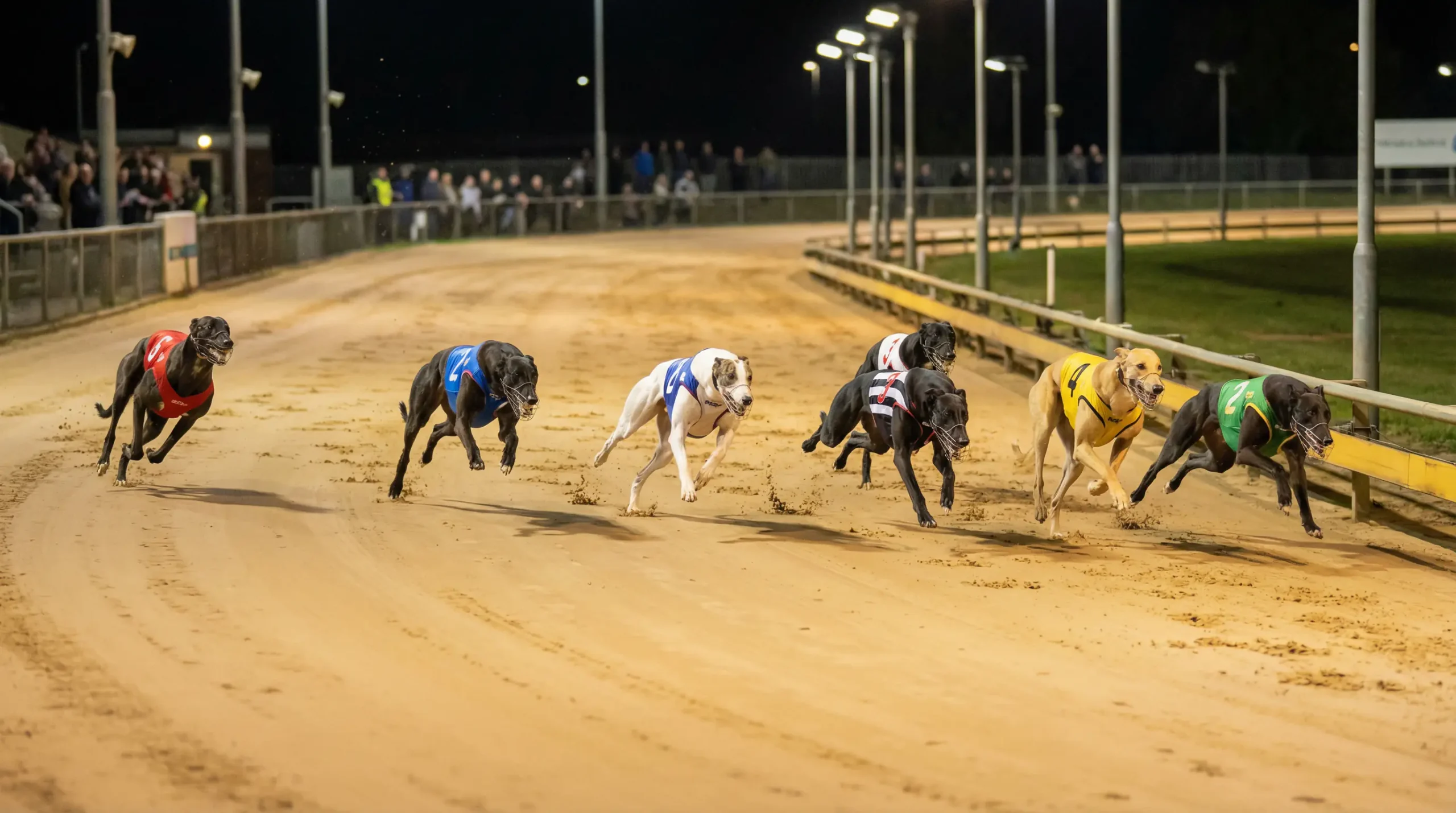
Graded races are the backbone of every UK greyhound meeting. The racing manager assesses each dog’s recent form and allocates it a grade — A1 through A11 for standard distance, S grades for stayers, D grades for sprints — and then constructs races by grouping dogs of the same grade together. The aim is competitive balance: six dogs of roughly equal ability racing each other, producing close finishes that are entertaining to watch and challenging to predict.
The grading system is imperfect by design. No classification method perfectly captures every dog’s current ability, and dogs that are improving, declining, or returning from a break may be mis-graded in either direction. These imperfections are where form readers find their edge in graded racing — identifying dogs whose grade doesn’t accurately reflect their current ability.
Open races carry no grade restriction. A dog graded A1 can line up alongside a dog graded A6 in the same race. In practice, open races attract the better dogs at a track because they often carry higher prize money and prestige, and trainers enter their strongest runners rather than their also-rans. The result is that open fields tend to be stronger on average than graded fields, but they can also include one or two dogs that are significantly outclassed by the rest.
At Doncaster, open races appear most frequently on the Saturday evening card — the premium session of the week. They may also appear at special meetings, themed evenings, or as part of competition rounds (puppy derbies, invitation events). The race card designates open races with the OR tag, distinguishing them from graded events at a glance.
There are also semi-open formats where the grade restriction is relaxed but not eliminated. A race restricted to A1-A3 dogs, for example, isn’t fully open (it excludes lower grades) but is less restrictive than a standard single-grade event. These intermediate formats share characteristics of both open and graded races and should be assessed with the principles of both in mind.
Field Quality Differences
The most consequential difference between open and graded races is the range of ability within the field. In a well-graded A5 race, the six dogs should be closely matched — they’ve all been assessed at the same level, and while individual performances vary, the ability gap between the best and worst dog in the field is typically narrow. This compression of talent is what makes graded races competitive and relatively unpredictable.
Open races have a wider ability range. The field might include two dogs of genuine A1 quality, two that are A3 standard, and two that are marginally competitive at A4 or A5. The top dogs in an open race are often clearly superior to the bottom of the field, which might seem to make the race more predictable — back the best dog and collect. But the dynamics are more complex than that.
When two or three high-class dogs meet in an open race, they’re racing against opponents of comparable ability for the first time in potentially several weeks. In graded racing, they’ve been competing against their own grade level and winning or placing routinely. In an open race, they face each other — and the outcome between closely matched top dogs is inherently uncertain. The race within the race is between the principals, and it’s often tighter and less predictable than the overall quality of the field would suggest.
The weaker dogs in an open field serve as supporting characters. They rarely win, but they influence the race dynamics — taking up trap positions, providing traffic for the leading dogs to navigate, and occasionally causing interference that benefits an outsider. A dog that’s been cleanly winning A4 races might not threaten the principals in an open race, but if it breaks fast from trap 1 and sets a strong pace, it can disrupt the expected race shape and create an opportunity for a closer to pick off tiring leaders.
How Betting Markets Differ
The betting market treats open and graded races differently, and understanding that treatment is essential for finding value in each format.
In graded races, the market is relatively balanced. The prices reflect a field of similarly rated dogs, and the spread between favourite and outsider is typically narrow — the favourite might be 2/1 and the outsider 6/1. The bookmaker’s overround is distributed relatively evenly, and the market is efficient because the form of each dog is directly comparable (they’re all racing at the same grade level, often with recent runs against each other).
In open races, the market is more polarised. The two or three principals are priced as short-priced favourites — perhaps evens and 5/2 — while the supporting runners are pushed out to 8/1 or longer. The bookmaker’s overround is concentrated in the shorter prices, where the perceived certainty is highest. This polarisation creates a specific value dynamic: the short-priced dogs are often underpriced relative to their true winning chance (because the market overestimates the certainty of form superiority translating into a win), and the longer-priced dogs are sometimes overpriced (because the market underestimates the possibility of interference, pace disruption, or an off day from a principal).
The practical implication: opposing short-priced favourites in open races can be a viable long-term strategy. When two strong dogs are expected to fight out the finish, the chance that one of them has an off day, encounters trouble, or is beaten by the other creates enough uncertainty that the favourite’s price often doesn’t compensate for the risk. The second or third best dog in the field, priced at 3/1 or 4/1 because the market has focused its attention on the clear favourite, can represent value if the race dynamics (trap draw, pace map, running style) set up in its favour.
Forecast betting in open races can be productive when the principals are clearly separated from the rest of the field. If three dogs are priced between evens and 3/1 and the other three are 10/1 or longer, a combination forecast covering the three principals reduces to six permutations — a manageable cost for a bet that covers the most likely first-second combinations. The dividend will be modest (short prices suppress the CSF), but the hit rate should be higher than in a graded race where any of the six dogs could realistically fill the places.
Which Race Type Suits Your Style
The choice between focusing on graded races and open races isn’t binary — most Doncaster bettors engage with both — but your emphasis should align with your analytical strengths and betting style.
Graded races reward detailed, granular form analysis. The fields are closely matched, which means the bettor who can identify small advantages — a favourable trap draw, a sectional-time edge, a running comment that excuses a poor result — has the best chance of separating the field. The returns per bet are moderate (the prices are compressed), but the volume of graded races on every card provides a steady stream of opportunities. If your strength is patient, systematic form work across a full card, graded races are your natural territory.
Open races reward a different skill: assessing class differentials and race dynamics between unevenly matched opponents. The key question in an open race isn’t “which dog has the best recent form?” — it’s “which dog handles this level of competition, this pace, and this field shape best?” The analysis is more holistic and less data-driven, relying on broader assessments of a dog’s quality rather than the granular details that separate graded rivals. If your strength is reading the quality and dynamics of a race rather than parsing form lines digit by digit, open races may suit your approach.
Both race types have different variance profiles. Graded races, with their tighter fields, produce more unexpected results — the margins are small enough that any of the six dogs can win on its day. Open races, with their clearer class hierarchy, produce fewer upsets but concentrate the contention among fewer dogs. This means graded races suit bettors comfortable with a lower strike rate and longer losing runs, while open races suit bettors who prefer a higher strike rate with correspondingly shorter prices.
Grade Your Own Approach
Open and graded races are two expressions of the same sport, and neither is inherently better for betting than the other. What matters is whether your method matches the format. Apply fine-grained form analysis to graded races where the details separate closely matched dogs. Apply broader quality and dynamics assessment to open races where class and race shape determine the outcome. Recognise which format is in front of you before you start analysing it, and adjust your tools accordingly. The race type you bet on should match the type of analysis you’re best at — and that alignment, more than any single form factor, determines your long-term results.