Best Greyhound Betting Sites – Bet on Greyhounds in 2026
Loading...
Not All Traps Are Equal at Meadow Court
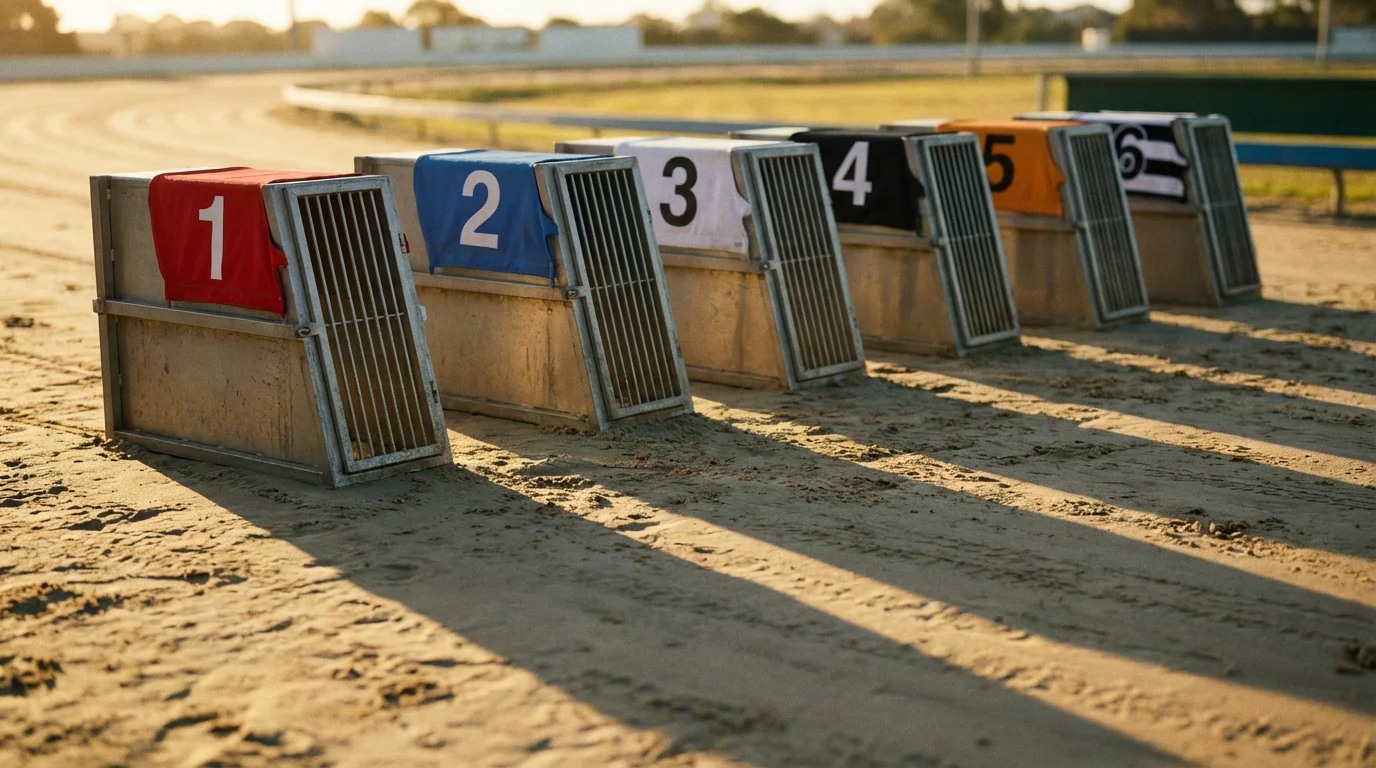
The starting box a dog draws from at Doncaster is a variable most bettors glance at and then forget. That’s a mistake. Trap draw sits alongside form and grade as one of the three factors that most reliably predict finishing positions, yet it gets a fraction of the attention that a dog’s last three runs receive.
Doncaster’s Meadow Court Stadium runs races over four distances — 275, 483, 661, and 705 metres (UK Dog Racing) — and the trap bias profile shifts significantly from one distance to the next. A trap that dominates at the sprint doesn’t carry the same advantage over the stayers’ trip. Understanding those differences is the starting point for anyone serious about using trap data as a practical betting tool rather than a casual afterthought.
What follows is a breakdown of how trap position influences results at each Doncaster distance, grounded in the physical characteristics of the track itself: a 438-metre circumference, a 105-metre run to the first bend, and a sand surface that plays differently depending on conditions (BettingOdds.com). The numbers tell a story — but only if you read them in context.
Trap Stats at 275 Metres
Sprint distance, short run-up, and only two bends — the 275-metre trip at Doncaster is where trap draw carries the most weight. The run to the first bend at this distance is compressed relative to the four-bend trips, which means dogs have less time to find a racing line before the field hits the turn. Inside traps gain a geometric advantage simply because they have less ground to cover.
Across a sustained sample of 275m races at Meadow Court, trap 1 consistently returns the highest win rate, typically sitting in the region of 25–30 per cent. That’s well above the theoretical 16.7 per cent you’d expect if all traps were equal in a six-dog race. Trap 2 tends to follow as the second most productive, though the margin over traps 3 and 4 narrows. Trap 5 and trap 6 are the clear underperformers at this distance, and the data is not ambiguous about it.
The explanation is mechanical. In a two-bend sprint, the inside dog reaches the first bend with the shortest arc. If it breaks level or ahead, it claims the rail and the race becomes a procession. Dogs drawn wide need to break significantly faster just to arrive at the bend without losing ground, and that’s before accounting for the likelihood of traffic on the outside line.
There are exceptions. A wide-drawn dog with a known fast break — sectional times significantly quicker than the rest of the field — can overcome the trap disadvantage. But across volume, the inside bias at 275m is one of the most reliable patterns at Doncaster. Punters who back dogs from trap 5 and trap 6 at this distance without a compelling speed reason are fighting the track itself.
One detail worth noting: the bias is strongest in lower grades, where the field is more tightly matched and break speed is less differentiated. In open or high-grade sprints, sheer ability can override trap position — but that’s the exception, not the rule.
Trap Stats at 483 Metres
At the standard distance, Doncaster’s 105-metre run to the first bend equalises things more than punters expect. That long straight gives all six dogs a genuine opportunity to sort out their positions before the first turn, which dilutes the mechanical advantage that inside traps enjoy at shorter trips.
The 483-metre race involves four bends, and the additional running gives pace dynamics more room to develop. A dog drawn in trap 6 that possesses strong early speed can use that long run-up to cross and claim a prominent position by the time the field reaches the bend. Conversely, a slow-breaking trap 1 dog has less of an automatic lifeline than it would at 275m — if it’s beaten for pace, four bends is enough distance for the deficit to compound.
The trap statistics at 483m still show a mild advantage for traps 1 and 2, but the magnitude is considerably smaller than at the sprint. Trap 1 win rates at this distance tend to hover around 19–22 per cent — above the 16.7 per cent baseline, but not by the decisive margin seen in sprints. Trap 6 win rates, meanwhile, climb to something closer to 13–15 per cent, which is below par but not catastrophic.
What matters more at 483m is the interaction between trap draw and running style. A confirmed railer in trap 1 is in its element. The same railer drawn in trap 4 faces a fundamentally different race. Wide runners flagged with a (W) designation on the race card often perform best from traps 5 and 6, where they have room to run their natural line without being squeezed against the rail by dogs inside them.
The practical takeaway: at 483m, treat trap draw as a modifier rather than a primary factor. A dog with superior form and a compatible trap is worth backing. A dog with superior form but an incompatible trap requires a harder look. Trap statistics at this distance function best as a filter to adjust your confidence level, not as a standalone selection tool.
Seasonal variation also affects 483m trap data. In winter, when sand runs heavier, inside traps can regain a slight edge because the energy cost of running a wider arc through heavy ground is higher. In fast summer conditions, the trap advantage flattens further. Track conditions and trap data are inseparable at this distance.
Trap Stats at 661m and 705m
Stayers distances at Doncaster — 661 and 705 metres — level the trap playing field to its flattest point. The additional bends and the sheer length of these races mean that trap draw fades as a determining factor. Stamina, sustained pace, and tactical racing take over.
At 661m, the field negotiates six bends. At 705m, it’s closer to seven depending on where the start box is positioned. That many turns allows for significant in-race positional changes. A dog drawn wide but possessing strong stamina and racing intelligence can find gaps and make progress through the field in ways that are simply not possible over two bends.
The statistics reflect this. Trap win rates at these distances cluster much more tightly around the 16–18 per cent band, with no single trap showing a decisive edge. If anything, middle traps (3 and 4) occasionally show a marginal advantage because they avoid both the rail crowding that can affect trap 1 and the wide arc that penalises trap 6 through the opening bends.
Dogs designated as wide runners tend to fare relatively well at stayers distances regardless of draw. With more bends to negotiate, a wide runner has multiple opportunities to make ground on the outside, and the stamina demands of the longer trip tend to expose dogs that relied purely on early pace at shorter distances. The 705m trip in particular is an equaliser — it rewards dogs that can maintain pace through the final straight rather than those who broke fastest.
For bettors, the lesson is clear: if you’re analysing a stayers race at Doncaster and trap draw is your primary differentiator between two evenly matched dogs, you’re looking at the wrong variable. At these distances, focus on recent form over similar trips, stamina indicators in the form guide, and whether the dog has previously handled six or more bends without fading.
Applying Trap Data to Your Selections
Raw trap percentages are a filter, not a verdict. Knowing that trap 1 wins 27 per cent of 275m races tells you something useful — but it doesn’t tell you to back every dog drawn in trap 1 at sprint distance. The data is a starting point, and what you layer on top of it determines whether it helps or misleads.
The first step is matching trap statistics to race distance. A punter who applies overall trap stats — aggregated across all distances — to a specific race is introducing noise into their analysis. Trap 1’s advantage at 275m is real; its advantage at 705m is negligible. Conflating the two produces a number that reflects neither distance accurately.
Second, cross-reference trap position with the dog’s running style. The race card will flag dogs as wide runners (W) or middle runners (M). A wide runner drawn in trap 1 is being forced into an unnatural racing line, and that mismatch matters more than the trap’s overall win rate. Similarly, a confirmed railer in trap 6 faces an uphill task at any distance.
Third, factor in the rest of the field. Trap statistics measure the box, not the dog in it. If a strong railer occupies trap 2 and a moderate railer sits in trap 1, the trap 2 dog may well squeeze the trap 1 runner into the rail at the first bend. The trap stat for box 1 assumes an average runner — your job is to account for the specific runner drawn there today.
Finally, weight your trap analysis appropriately. At 275m, it’s a primary factor — arguably the most important single data point. At 483m, it’s one variable among several. At 661m and beyond, it’s background information. Adjusting the weight you give trap data by distance is the single most effective way to avoid the common trap bias pitfalls.
The punters who profit from trap statistics aren’t the ones who memorise them — they’re the ones who know when each stat matters and when to set it aside.
The Box Is Only the Beginning
A trap stat tells you the probability; the form tells you the dog. Neither is complete without the other, and the punters who treat trap data as gospel are making the same error as those who ignore it entirely — they’re working with half the picture.
Doncaster’s trap statistics are stable enough to be useful and variable enough to require judgement. The 105-metre run to the first bend gives this track a distinctive character that separates its trap dynamics from tighter circuits like Romford or Crayford. Respect that difference, apply the data with distance-appropriate weight, and the starting box becomes what it should be: one well-calibrated tool among several in your selection process.
The box is where the race begins. It’s never where the analysis should end.