Best Greyhound Betting Sites – Bet on Greyhounds in 2026
Loading...
Levelling the Track
Handicap races in greyhound racing attempt to do what the grading system does imperfectly: give every dog in the race an equal chance of winning. Where graded races group dogs of similar ability and let them race from the same starting line, handicap races take dogs of different abilities and stagger their starting positions to compensate for the speed difference. The faster dog starts further back; the slower dog starts further forward. In theory, they cross the finish line together. In practice, the handicapper’s judgement is an approximation — and the gaps between the approximation and reality are where bettors find their angles.
Handicap greyhound races are less common than graded races at most UK tracks, but they appear regularly enough on the schedule — including at Doncaster — to warrant understanding. The form-reading approach is different, the betting dynamics are different, and the way you assess each dog’s chances requires an adjustment from the standard graded-race method.
This guide covers the structure of handicap races, how to read handicap form, the impact of distance allowances on the race, and the betting considerations specific to handicap events.
How Handicap Races Are Structured
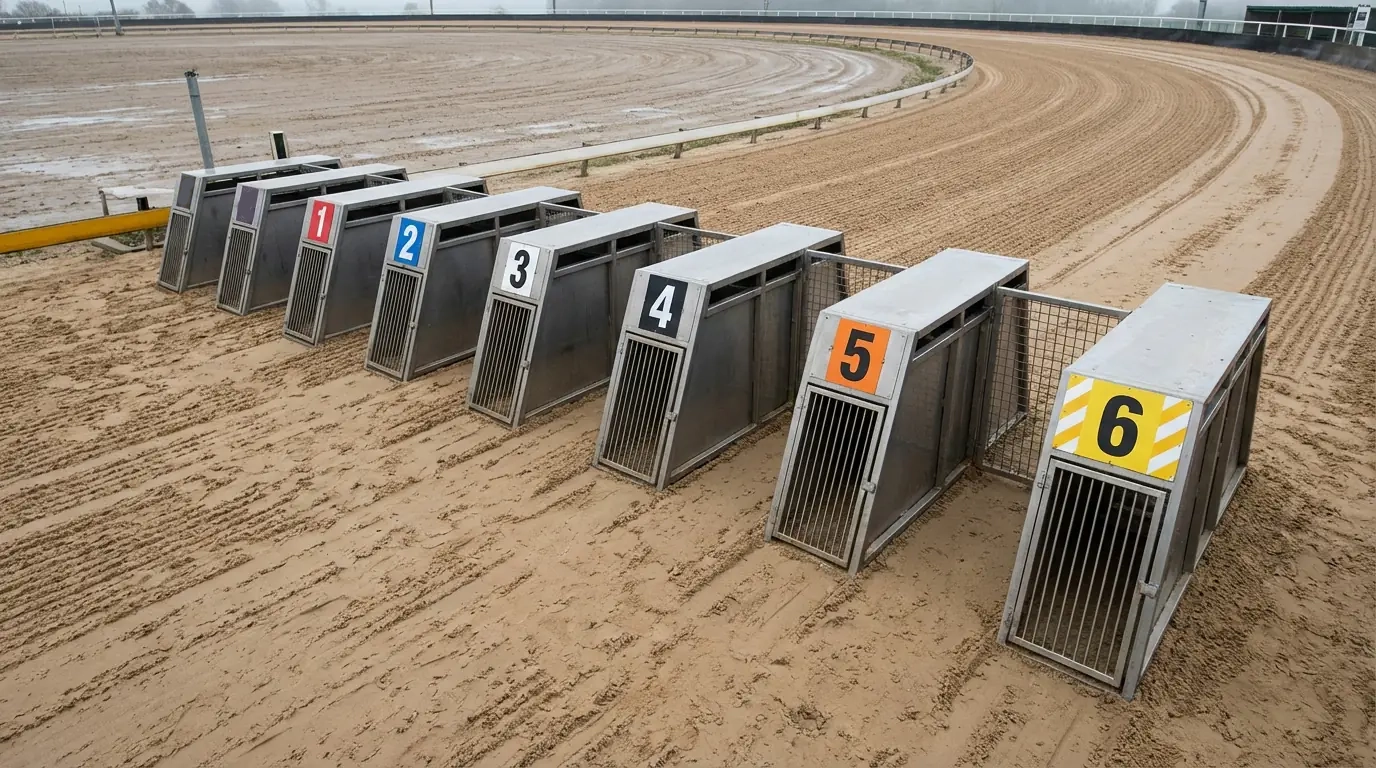
In a standard greyhound race, all six dogs start from the same line of traps. In a handicap race, the starting positions are staggered. Dogs are assigned starting marks based on their assessed ability — measured primarily by their recent race times and grades. The fastest dog in the field starts from the furthest-back mark (scratch), and the slowest dog receives the maximum start allowance, beginning several metres ahead of the scratch dog.
The handicapper — typically the racing manager at the track — sets the marks by analysing recent form, focusing on calculated times or recent finishing times adjusted for conditions. The difference in ability between two dogs is translated into a distance allowance. If Dog A’s form times suggest it’s approximately one second faster than Dog B over the race distance, and one second equates to roughly six lengths at racing speed, Dog B might receive a six-length start over Dog A.
The allowances are expressed in metres. A typical Doncaster handicap might see the scratch dog on the zero-metre mark and the most generously treated dog receiving a 10 to 15-metre head start. The intermediate dogs receive allowances scaled between these two extremes. The marks are published on the race card alongside the trap draw, so punters can see exactly how much start each dog receives.
Handicap races are usually run over standard distance at the host track — 483 metres at Doncaster — with the staggered starts effectively shortening the distance for dogs on the front marks and lengthening it for dogs on the back mark. This means the race is not truly run over the same distance for every dog, which has implications for how you assess each runner’s stamina and finishing effort.
The trapping mechanism in handicap races can vary. Some tracks use a staggered trap system where each trap is physically positioned at the appropriate mark. Others use a standard trap line with the front-mark dogs released fractionally before the back-mark dogs via a sequential trapping mechanism. The specific method used at Doncaster is published in the race conditions, and it affects how cleanly each dog breaks — dogs on non-standard marks may trap less cleanly than they would from a conventional start.
Reading Handicap Form
Form from handicap races requires careful interpretation because the finishing positions don’t mean what they mean in a standard graded race. A dog that finished first in a handicap did so from a specific mark — and understanding that mark is essential to assessing whether the win was dominant, expected, or assisted by a generous allowance.
When you see a handicap result in a dog’s form line, check the mark the dog was running off. A dog that won a handicap off scratch — the back mark, receiving no allowance — produced the best performance in the field, because it gave start to every other runner and still won. That’s a genuine form boost. A dog that won off the front mark — receiving the maximum allowance — may have benefited from the handicapper’s generosity more than from its own ability. The win still counts, but its predictive value for the dog’s next race (which may be a graded event off level terms) is lower.
The margin of victory in handicap races is more informative than in graded races. In a well-handicapped field, the finishers should be closely bunched — the staggered starts are designed to produce a tight finish. If a dog wins a handicap by four lengths from scratch, the handicapper significantly underestimated its ability, and the dog is likely to be reassessed upward for its next handicap entry. If a front-mark dog wins by a neck, the handicap was fair and the win reflects the allowance working as intended rather than the dog being materially better than the field.
Handicap form should also be compared against the dog’s graded form, where available. If a dog has been struggling in A5 graded races (finishing fourth and fifth) but won a handicap off a generous front mark, the handicap win doesn’t necessarily indicate a form reversal. It may simply mean the handicapper gave it enough start to compensate for its current ability deficit. Check whether the winning time, adjusted for the allowance, would have been competitive in a graded race at the appropriate level. If it wouldn’t, the handicap win is less meaningful than it appears.
Distance Allowances and Their Impact
The distance allowances in greyhound handicaps have cascading effects beyond simply giving some dogs a head start. They change the race dynamics in ways that aren’t always obvious from the card.
Front-mark dogs run a shorter effective distance. A dog receiving a 10-metre start in a 483m handicap is effectively running 473 metres. Over a full race, that 10-metre reduction is modest — roughly 0.6 seconds at racing speed — but it affects the stamina demand. A dog that fades over the final 50 metres of a 483m race may not fade over 473 metres because it hits the line before the stamina gives out. Front-mark allowances can mask stamina limitations that would be exposed in a standard-distance graded race.
Back-mark dogs face a different challenge: they’re running from behind. Even though they’re theoretically faster than the front-mark dogs, they start the race trailing by 10 or 15 metres and must close that gap while also dealing with the tactical complications of running through traffic. A scratch dog might be the best dog in the field on raw ability, but if it gets caught behind slower dogs through the first two bends, the allowance works against it because it can’t use its speed advantage.
This creates a bias in handicap racing toward front-mark dogs with decent early pace. A dog that receives a start and also traps quickly can establish an early lead that the scratch dogs, running from behind, may never bridge. The back-mark dog may be closing through the final straight, but if the front-mark runner has maintained just enough of its advantage, the allowance holds. Punters who focus solely on which dog is the best on raw form often back the scratch dog and get frustrated when it can’t close the gap — the allowance is doing its job.
The handicapper’s accuracy varies. Some handicap races are finely balanced — the field finishes within two lengths of each other, and the handicapper got it right. Others are lopsided — one dog wins by five lengths despite giving start, or a front-mark dog is never challenged because the allowance was too generous. Over time, the handicapper’s accuracy at a specific track is itself a data point. If Doncaster’s handicapper consistently underestimates certain types of dogs (for instance, improving puppies or dogs returning from a break), that systematic error is exploitable.
Betting on Handicap Greyhound Races
Handicap races are structurally different from graded races, and the betting approach should reflect that. The most common mistake is treating the scratch dog as the automatic favourite based on raw ability. In a well-crafted handicap, the scratch dog’s ability advantage is offset by the allowances given to the other runners. The market should price each dog closer to equal chances than in a graded race — and when it doesn’t, when the scratch dog is sent off as a short-priced favourite, there’s often value in opposing it.
Front-mark dogs with early pace are the most reliable betting propositions in handicap races. They combine a physical head start with the ability to convert that start into an early lead, which is the most difficult position for back-mark dogs to overturn. If a front-mark dog also has a favourable inside trap draw — minimising the distance it runs through the first bend — the combination of allowance, pace, and draw creates a strong chance.
Avoid backing dogs on the back mark unless their recent form is significantly better than the handicapper’s assessment suggests. If a dog has improved since the handicapper set the marks — for instance, it won a graded race impressively between the mark-setting date and the handicap race date — the back mark may be too lenient and the dog is effectively better than scratch. These improvers represent value on the back mark; dogs whose form matches the handicapper’s assessment do not.
Forecast betting in handicaps is more unpredictable than in graded races because the staggered starts add an additional variable to the finishing order. Unless you have a strong view on both the likely leader and the likely closer, handicap forecasts are high-variance bets. Win and each-way betting is generally more appropriate for handicap events, with each-way terms offering useful insurance on front-mark selections that may be caught close to the line.
The Great Equaliser
Handicap races are the racing manager’s attempt to make every dog a contender regardless of grade. The staggered starts compress the ability range into a narrow finishing window, which makes handicaps more unpredictable than graded races but also more interesting for bettors who can read the allowances rather than just the form. The market routinely overvalues the scratch dog and undervalues front-mark runners with tactical advantages — and that pricing error, repeated across enough handicap events, is an edge worth having.