Best Greyhound Betting Sites – Bet on Greyhounds in 2026
Loading...
The Rules Behind the Race
Greyhound racing in the UK operates within a regulatory framework governed by the Greyhound Board of Great Britain. The GBGB is the sport’s governing body — it sets the rules of racing, licenses tracks, registers dogs and trainers, enforces welfare standards, and administers the disciplinary process. Every race you watch at Doncaster, every result you read on a form guide, and every bet you place on a licensed meeting exists within the structure that the GBGB maintains.
For bettors, the GBGB’s role is mostly invisible. The rules are set, the meetings are scheduled, the results are published — and the bettor engages with the output rather than the governance. But understanding the regulatory structure gives context to aspects of the sport that directly affect form and betting: how grading works, why dogs move between tracks, how injuries are handled, and what happens to greyhounds when their racing careers end. The regulation isn’t separate from the racing — it shapes it.
The GBGB’s Role
The Greyhound Board of Great Britain operates as the sport’s self-regulatory body. It was established in its current form in 2009, replacing both the National Greyhound Racing Club and the British Greyhound Racing Board (GBGB), and its remit covers all aspects of licensed greyhound racing in the UK. The GBGB is not a government body — it’s an independent organisation funded by the sport itself, primarily through a voluntary levy on bookmakers’ greyhound betting turnover.
The GBGB’s core functions include setting and enforcing the Rules of Racing — the comprehensive rulebook that governs everything from race procedures to drug testing. It registers every greyhound that races at a licensed track, maintaining a database of pedigrees, race records, and ownership. It licenses trainers, requiring them to meet standards of competence, facility provision, and welfare compliance before they can operate. It appoints and oversees racing officials — stipendiary stewards, veterinary surgeons, and race readers — who are present at every licensed meeting.
The disciplinary function is significant. The GBGB has the power to suspend or disqualify trainers, fine kennel staff, and withdraw dogs from racing if rules are breached. Doping violations, interference with the running of a race, and welfare breaches are all subject to disciplinary action. The outcomes of disciplinary inquiries are published, and for serious bettors, these publications occasionally flag trainers or dogs whose form may have been affected by practices that are now subject to sanction.
One aspect of the GBGB’s role that matters directly to bettors is the regulation of race integrity. The GBGB operates an integrity unit that monitors betting patterns for suspicious activity. If a race produces results that correlate with unusual market movements — for example, a heavily laid favourite that performs far below expectation — the integrity team investigates. These investigations are conducted quietly and their results are not always made public, but they’re an important backstop against corruption in the betting market.
The GBGB also maintains the greyhound register, which is the official record of every dog’s identity, ownership, and racing history. The register is the basis for the form data that punters rely on — without it, there would be no verified race history, no reliable form guides, and no confidence that the dog running tonight is the same dog whose form you’ve been studying. The register is the unglamorous backbone of the entire form-reading enterprise.
Track Licensing Standards
Every track that hosts licensed greyhound racing in the UK must meet the GBGB’s facility and operational standards. Doncaster’s Meadow Court Stadium holds a GBGB licence (doncastergreyhoundstadium.co.uk), which means it’s been inspected and certified to meet requirements covering track surface quality, kennelling facilities, veterinary provision, and safety standards for both dogs and public.
Track surface standards specify minimum requirements for the racing surface — sand composition, depth, drainage, and maintenance. The GBGB conducts periodic inspections to ensure that track surfaces are maintained to a standard that minimises injury risk. For bettors, this means that any GBGB-licensed track should provide a surface that is reasonably consistent and safe, though conditions still vary between meetings as discussed in the track conditions guide.
Kennelling standards require that tracks provide adequate facilities for dogs before and after racing: clean, temperature-controlled kennel accommodation, secure exercise areas, and veterinary examination rooms. Dogs are kennelled at the track before their race and examined by the attending veterinary surgeon. Any dog found to be unfit to race — through injury, illness, or condition concerns — is withdrawn before the card is finalised.
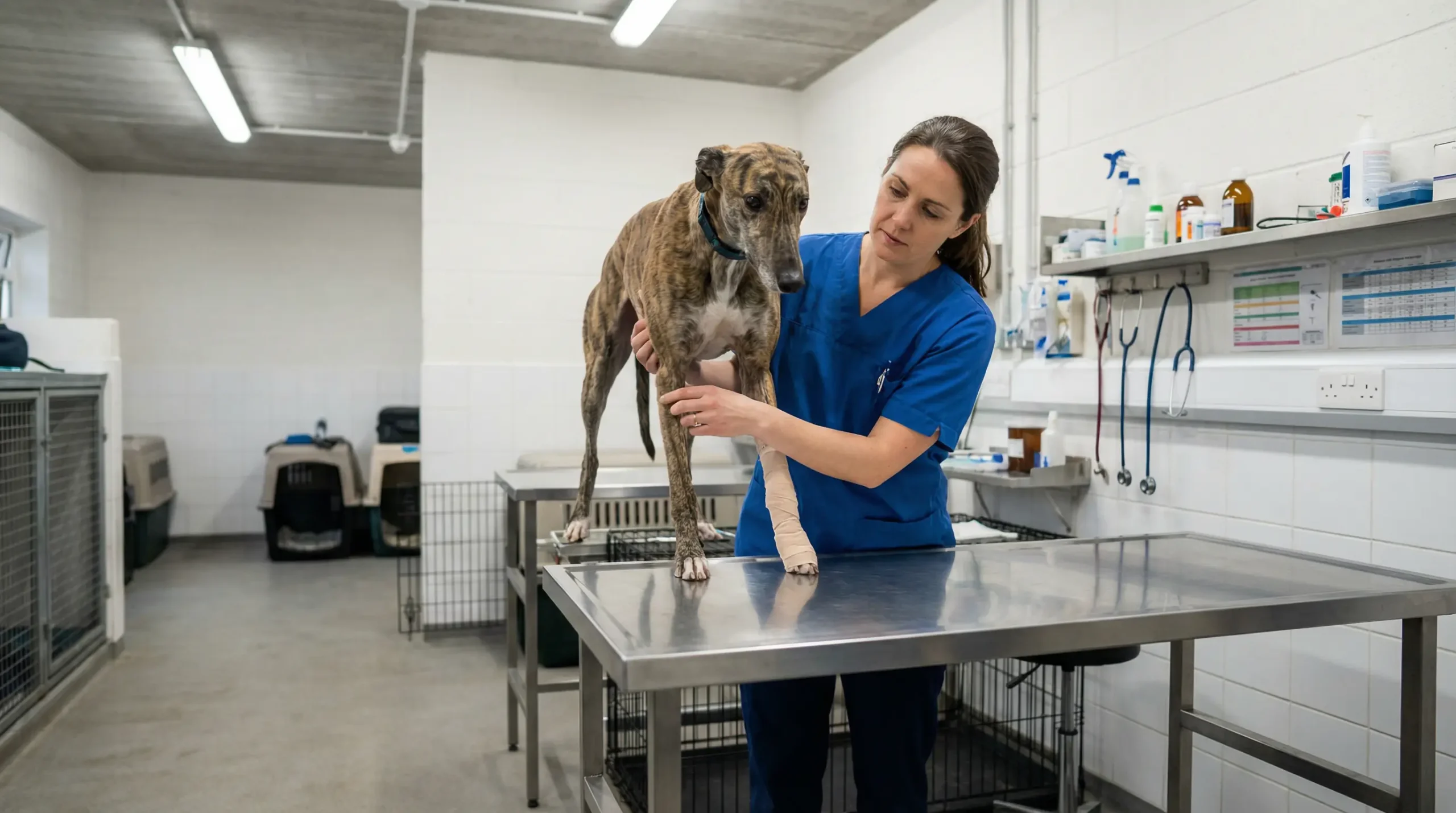
The requirement for veterinary presence at every licensed meeting is one of the more consequential standards for both welfare and form. The vet examines every dog before racing and is on hand throughout the meeting to treat injuries. Post-race, dogs that have sustained injuries are examined and their condition is recorded. This veterinary oversight means that injuries are documented, which feeds into the form record — if a dog’s next outing is delayed, the reason is usually an injury identified by the track vet.
Tracks that fail to meet licensing standards can have their licence revoked or suspended, which effectively ends their ability to host licensed racing. This has happened to several UK tracks over the years, and the threat of licence revocation provides a meaningful incentive for track operators to maintain standards.
Greyhound Welfare and Retirement
Welfare is the most scrutinised aspect of greyhound racing, and the GBGB’s welfare provisions have expanded significantly in recent years in response to public concern and political pressure. The current framework covers dogs from registration through racing career and into retirement — a cradle-to-grave approach that aims to account for every greyhound that enters the licensed system.
During their racing careers, greyhounds are subject to welfare rules that cover housing, feeding, exercise, and veterinary care. Trainers must provide accommodation that meets specified standards, ensure dogs receive appropriate nutrition and exercise, and arrange veterinary treatment when needed. The GBGB conducts unannounced kennel inspections to verify compliance, and trainers found in breach of welfare standards face disciplinary action.
The retirement question — what happens to greyhounds when they stop racing — is the issue that generates the most public attention. The GBGB operates the Greyhound Retirement Scheme, which tracks and facilitates the rehoming of retired racing greyhounds (GBGB FAQs). Under current rules, trainers and owners must notify the GBGB of the retirement of every registered greyhound and confirm the dog’s destination — whether it’s been rehomed, retained by the owner, or transferred to a rehoming charity.
The Greyhound Trust (greyhoundtrust.org.uk) and numerous independent rehoming organisations work alongside the GBGB scheme to place retired dogs in domestic homes. Greyhounds make excellent pets — they’re typically gentle, calm, and low-energy outside of racing — and the demand for retired greyhounds from the public has grown steadily. The GBGB publishes annual statistics on rehoming rates, and the proportion of racing greyhounds that are successfully rehomed has increased in each of the last several reporting periods.
Despite these provisions, welfare remains a subject of legitimate debate. Critics argue that the racing industry could do more to fund retirement care, that injury rates during racing are unacceptably high, and that the self-regulatory model — where the sport governs itself — creates conflicts of interest. The GBGB’s position is that standards have improved substantially and continue to improve, and that licensed racing provides a far higher welfare standard than unregulated or unlicensed greyhound activity.
Injury Protocols and Transparency
Injuries are an inherent risk in greyhound racing. Dogs running at speeds exceeding 40 miles per hour around sand bends are subject to muscular, skeletal, and soft-tissue injuries. The GBGB’s injury protocols aim to minimise this risk, treat injuries when they occur, and record them transparently.
At every licensed meeting, the attending veterinary surgeon examines dogs before and after racing. Any dog that suffers a visible injury during a race is treated on site and its condition assessed. Serious injuries are reported to the GBGB and recorded in the greyhound’s official record. If an injury is career-ending, the dog enters the retirement and rehoming process.
The GBGB publishes injury statistics annually, broken down by track, injury type, and severity. These statistics are publicly available on the GBGB’s website and provide a transparent record of the sport’s injury profile. Tracks with higher-than-average injury rates may face additional inspections or requirements to modify their surface, trap positions, or race scheduling to reduce risk.
For bettors, injury protocols have a direct form implication. A dog returning from injury may need several races to regain full fitness and sharpness. The form guide will typically show a gap in the form line corresponding to the injury layoff, and the first few runs back may not represent the dog’s true ability. Dogs returning from muscle injuries often need two or three outings to rebuild race fitness; dogs recovering from skeletal injuries may take longer and may never fully return to their pre-injury level.
The GBGB also mandates a minimum rest period between races for all dogs, which varies by distance raced. This regulation ensures dogs have adequate recovery time and reduces the risk of cumulative fatigue injuries. The minimum rest periods are factored into the race scheduling system, so if a dog appears on a card, it has met the required recovery period since its last outing — but minimum rest is not the same as optimal rest, and some dogs perform better with longer gaps between races.
The Sport’s Other Finish Line
Regulation is the scaffolding around greyhound racing — it’s not the race itself, but without it, the race has no integrity. The GBGB’s framework of licensing, welfare standards, integrity monitoring, and disciplinary enforcement provides the structure that makes form data reliable, results trustworthy, and the betting market credible. It’s imperfect, evolving, and subject to legitimate criticism on welfare grounds. But it exists, it functions, and it’s worth understanding because it shapes the sport you’re betting on in ways that go beyond the race card and the results page.