Best Greyhound Betting Sites – Bet on Greyhounds in 2026
Loading...
Where Most Races Happen
The 483m is Doncaster’s bread and butter — the distance that generates the most data, the most betting turnover, and the most reliable form. On any given meeting at Meadow Court Stadium, the majority of races are run over this trip. It’s the standard distance for A-grade racing, the benchmark for grading assessments, and the distance against which every Doncaster greyhound is ultimately measured.
Because 483m races dominate the schedule, the depth of available form data at this distance is substantially greater than at the sprint or stayers trips. More races mean more sectional times, more running comments, more grade movements, and more meaningful trap statistics. For punters focused on Doncaster, the 483m trip is where form analysis is most productive and where the results archive delivers the most actionable intelligence.
That depth of data, however, comes with a catch. The market is also at its most efficient at this distance. The 483m trip is where the most money is wagered, where the bookmakers price with the greatest care, and where casual and professional punters alike concentrate their activity. Finding value at the standard distance requires sharper analysis than at the less-traded sprint and stayers trips — but it’s also where consistent profits are most sustainable because the volume of opportunities is highest.
The 483m Race Shape
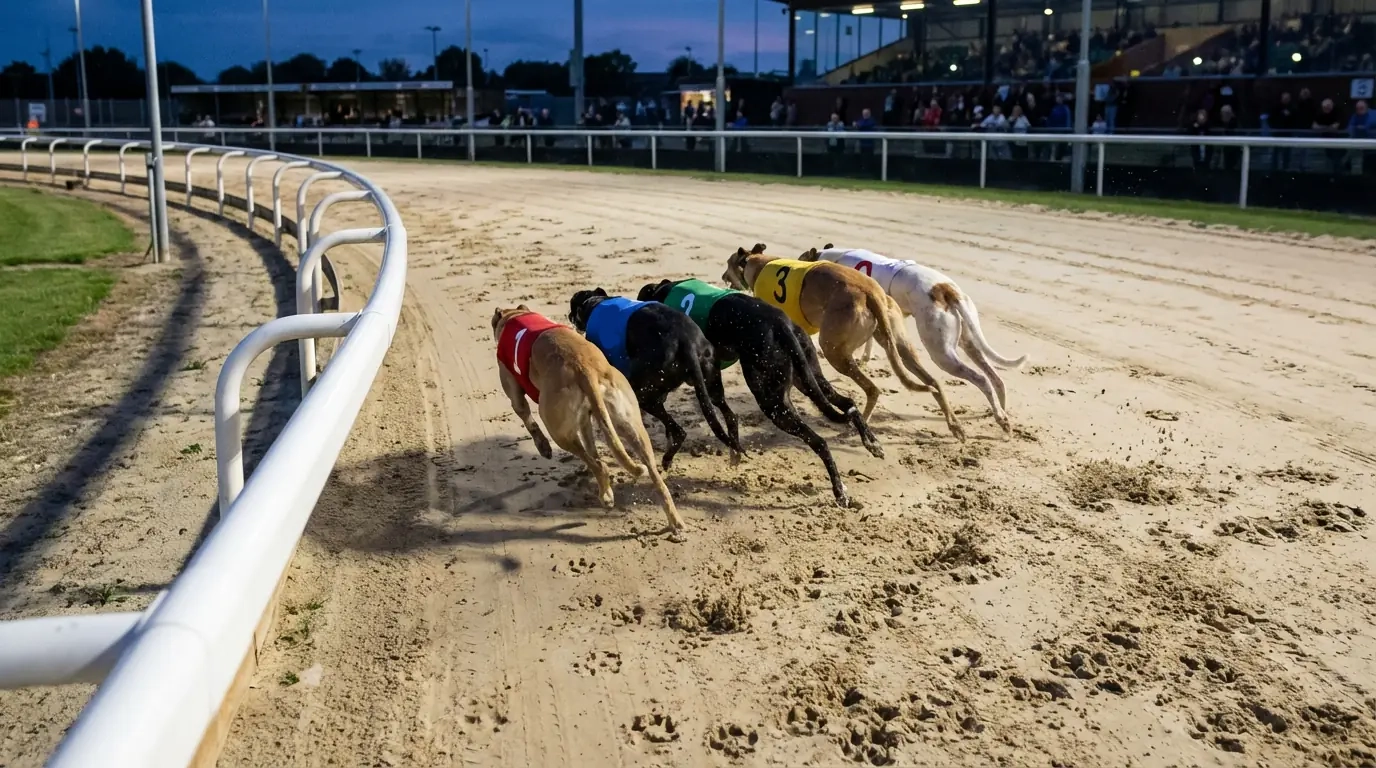
A 483-metre race at Doncaster involves four bends, and the way those bends interact with the track’s dimensions creates a distinctive race shape. The field breaks from the traps and covers the 105-metre run to the first bend (BettingOdds.com) — long enough for early speed to establish itself but not so long that the field is completely strung out before the turn. The first bend produces the most significant positional changes as dogs settle into their racing lines. The second and third bends are where mid-race pace is established, and the final bend into the home straight is where the race is decided.
The 105-metre run-up at Doncaster gives this distance a different character than the same trip at tracks with shorter run-ups. At a circuit like Crayford, where the run to the first bend is 77 metres (BettingOdds.com), the inside trap has a decisive advantage because there’s less time for dogs to sort positions before the bend. At Doncaster, the extra 28 metres of straight allows wider-drawn dogs to cross in or push out without the immediate chaos that a tight first turn produces. The result is that 483m races at Doncaster tend to be slightly more orderly through the opening bends than at tighter tracks, and the form is correspondingly more reliable.
The four-bend structure means that both early pace and sustained speed matter. Unlike the 275m sprint, where the break decides the race, the 483m trip requires dogs to maintain their effort through the middle of the race. A dog that leads through bends one and two but fades through bends three and four is running the wrong distance — it’s a sprinter stretched beyond its optimum. The ideal 483m dog combines a competitive break (not necessarily the fastest, but fast enough to be in contention at the first bend) with the stamina to hold its position or close through the final two bends.
The finishing straight at Doncaster is long enough to produce dramatic finishes. Dogs that are running on at the end of the back straight can gain two or three lengths through the final bend and the run to the line. This is where strong finishers — dogs with moderate sectionals but superior closing speed — make their runs. It’s also where races that looked settled through the middle of the trip are turned on their head, which is why 483m results at Doncaster are less dominated by front-runners than sprint results are.
Pace Maps at Standard Distance
Building a pace map for a 483m race at Doncaster starts with sectional times and trap draws. Rank the field by their most recent sectionals to identify who leads to the first bend. Then overlay the trap draw to assess whether the likely leader has a clean route or will face crossing traffic from a dog with a comparable sectional drawn outside.
A race with a clear early leader — one dog whose sectional is 0.3 seconds faster than the rest from a favourable trap — has a predictable pace map. That dog leads to the first bend, leads through bend two, and the question becomes whether it can sustain the pace or whether a closer from the back of the field can reel it in. In these races, the form of the leader and the closing ability of the chasers are the key variables.
A race where two or three dogs share similar sectionals from adjacent traps has a contested pace. This is where the first bend becomes a battleground. Dogs fighting for the lead through the first two bends tire each other out, creating space for a mid-pack runner or a closer to pick up the pieces. Contested-pace races at 483m are the most volatile race type at Doncaster and produce the most unexpected results, which makes them the worst races for short-priced favourites and the best for forecast and tricast bets.
The back half of the pace map matters as much as the front. Identify which dogs in the field have RnOn (ran on) or FinWl (finished well) comments in their recent form. These are the closers who benefit from a hot pace. If your pace map predicts a contested lead, a closer drawn in trap 4 or 5 — far enough from the early-speed battle to avoid it, close enough to strike through the final bends — becomes a strong candidate.
One subtlety: pace maps at Doncaster’s 483m are most reliable when the field is entirely comprised of dogs with recent form at the same distance. When dogs are stepping up from 275m or dropping down from 661m, their sectional profiles may not translate directly. A 275m specialist stepping up will likely post a fast sectional but fade; a stayers dog stepping down may be slow early but strong late. Factor these profile mismatches into the pace map rather than relying solely on the raw sectional numbers.
Grade Relevance at 483m
The grading system at Doncaster is built around the 483m trip. All A-grade designations — from A1 at the top to A11 at the bottom — are determined by a dog’s performance at this distance. A dog’s grade is essentially a statement about where it sits on the 483m competitive ladder, which means that grade changes at this distance carry more informational weight than at the sprint or stayers distances.
A grade drop at 483m is a direct signal that the racing manager believes the dog cannot compete at its current level over the standard trip. A grade rise says the opposite — the dog has outperformed its grade and is being tested against faster opposition. These movements generate the clearest betting signals at Doncaster because the 483m grading is the most granular and most frequently adjusted.
The average winning time per grade provides a useful benchmark. At Doncaster, each grade band corresponds to a roughly 0.15 to 0.25-second window in calculated time. An A4 dog is expected to run approximately 0.40 to 0.60 seconds faster than an A7 dog in calculated time terms. When a dog’s recent calculated times fall outside the expected range for its current grade — faster than grade standard or slower — it highlights a mismatch between grade and ability that the market may not have fully priced.
Dogs moving between grades at 483m should be assessed against their new opposition, not their old. A dog dropping from A4 to A5 isn’t automatically the best dog in the race — it’s been dropped because it was struggling at A4, and it may still be only marginally competitive at A5. The grade drop creates an opportunity, but only if the dog’s recent form and calculated times suggest it genuinely fits the new grade rather than having been dropped because it was struggling overall.
Form Factors Unique to 483m
Several form factors carry additional weight at 483m compared to other distances. First, consistency over the distance matters more than a single outstanding run. Because there are more 483m races to assess, a dog’s form line over six or eight runs gives a clearer picture of its ability than the peak performance alone. Look for dogs that repeatedly run within a narrow calculated-time band rather than those with one fast time and several moderate ones.
Second, running style is more influential at this distance than at sprints. The four-bend race allows for tactical variety: front-runners, stalkers, mid-pack runners, and closers all have viable paths to victory. At 275m, only front-runners are consistently competitive. At 483m, a closer with a moderate sectional but a strong finishing effort can win from off the pace. Knowing each dog’s running style — from its sectionals, running comments, and finishing patterns — is essential at this distance.
Third, the dog’s fitness and recent activity level matter. The 483m trip is long enough to expose a dog that isn’t at full fitness, particularly one returning from a break or switching tracks. Dogs with a recent run at the same distance are generally sharper than those coming in cold, and form from the last 14 days is significantly more reliable than form from a month ago.
The Distance That Defines the Track
Every Doncaster regular lives and dies by the 483m race. It’s where the grading is sharpest, the form is deepest, and the market is most contested. That combination makes it the hardest distance to beat consistently — and the most rewarding when you do.
The edge at 483m comes from layered analysis: calculated times for ability assessment, sectionals for pace mapping, running comments for context, grade movements for value, and trap draw as a final filter. No single data point wins at this distance. The punters who profit are the ones willing to combine all five, race by race, card by card, and accept that even the best analysis loses more often than casual observers would believe. The 483m defines Doncaster, and how well you read it defines your results.