

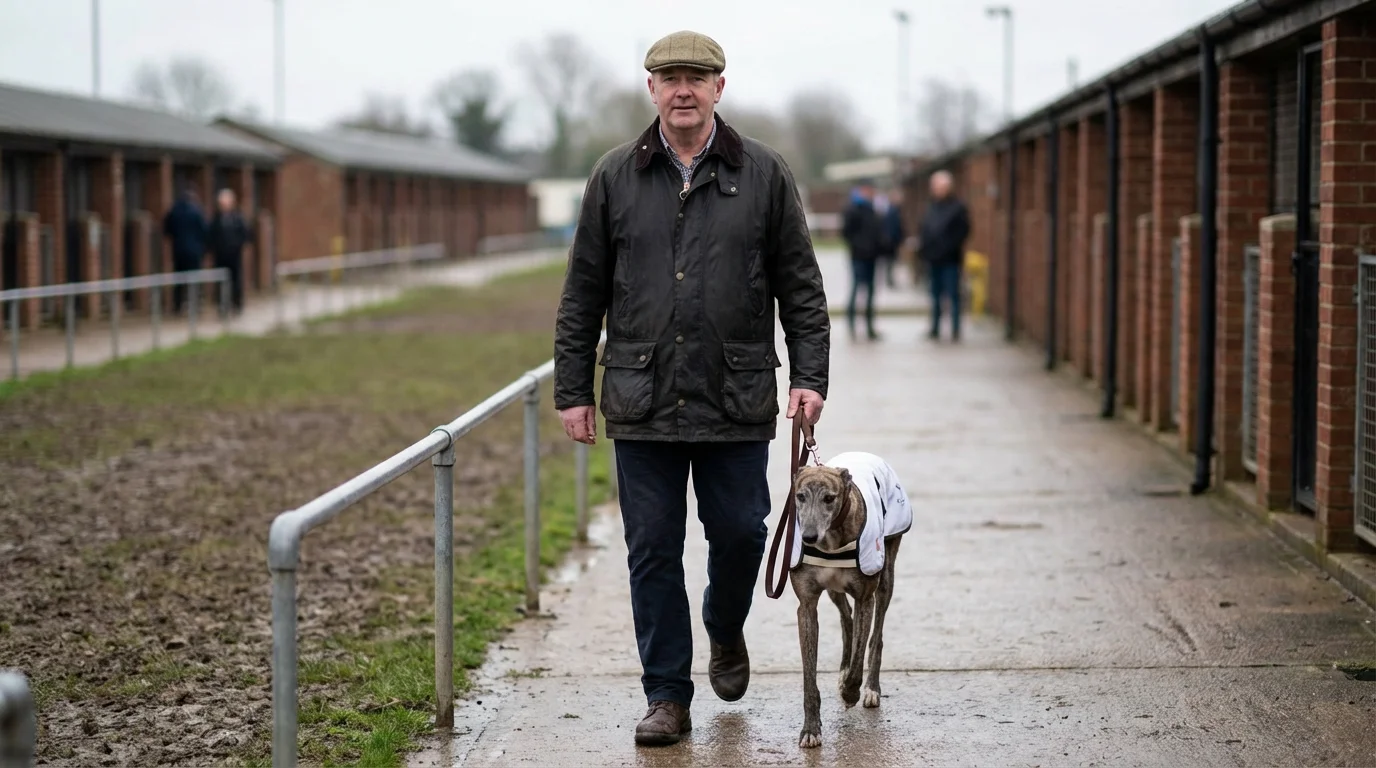
The Name Before the Name
Every greyhound on a Doncaster race card has a trainer listed next to it, and most punters skip past that detail without a second thought. The dog’s form, trap draw, grade — those get the attention. But the trainer’s name is data too, and for anyone willing to track it, it’s data with a surprisingly strong signal.
Trainers in UK greyhound racing are not passive custodians. They make the decisions that shape a dog’s career: when it races, which distance it runs, which meetings it targets, and how it’s prepared between races. A trainer with a strong strike rate at Doncaster isn’t lucky — they understand the track, manage their dogs intelligently, and place them in races where their chances are maximised. That pattern repeats, and repetition is what makes it useful for bettors.
This guide covers what trainer statistics actually include, how to calculate and interpret strike rates, how to read kennel form patterns, and the practical application of trainer data in your Doncaster selections.
What Trainer Stats Include
Trainer statistics aggregate the performance of every dog in a trainer’s kennel across a defined period. The core metrics are runners, winners, and strike rate — but the useful detail sits beneath those headline numbers.
Runners is the total number of individual starts by dogs trained by that kennel. A trainer with 200 runners at Doncaster in a 12-month period is an active participant at the track; one with 30 runners is an occasional visitor. The volume of runners matters because it determines the reliability of the other statistics. A trainer with a 30 per cent strike rate from 10 runners could be brilliant or could have had a lucky fortnight. A trainer with a 22 per cent strike rate from 200 runners is telling you something statistically meaningful about their operation.
Winners is the count of first-place finishes. Some form providers also record places (first or second in standard six-dog races), which gives a broader view of how often the trainer’s dogs are competitive rather than just winning. A trainer whose dogs finish first or second 45 per cent of the time but win only 18 per cent is placing dogs competitively — they’re in the right races, but they’re not always the best dog. A trainer with a 25 per cent win rate and a 50 per cent place rate is converting competitive positions into victories more efficiently.
Strike rate is the percentage of winners from total runners. It’s the single most referenced trainer metric, and it’s useful as a broad indicator but insufficient on its own. Strike rates need to be segmented by distance, grade, and time period to be genuinely informative. A trainer might have a 20 per cent overall strike rate at Doncaster but a 35 per cent strike rate in sprint races and a 12 per cent rate in stayers races. The overall number masks the specialisation, and the specialisation is where the betting value lies.
Profit or loss to level stakes is a metric some form providers calculate. It measures whether backing every runner from a specific trainer at starting price would have produced a profit or loss. A trainer with a positive level-stakes profit is one whose runners are, on average, underestimated by the market — their dogs win at prices that more than compensate for their losers. This is the closest thing to a direct measure of betting value associated with a trainer, though it requires a substantial sample size to be reliable.
Calculating Strike Rates
The arithmetic is simple: divide winners by runners and multiply by 100. If a trainer has had 40 winners from 200 runners at Doncaster, the strike rate is 20 per cent. The interpretation is where the skill lies.
A 20 per cent strike rate sounds solid — and in greyhound racing, it is. The baseline expected strike rate if every dog in every race had an equal chance would be 16.7 per cent (one in six). A trainer consistently above 20 per cent is placing their dogs effectively. Above 25 per cent over a meaningful sample (100+ runners) suggests a trainer who is both skilled and selective — they’re not entering dogs in races they can’t win.
But context shapes everything. A trainer who operates primarily in lower grades (A8, A9, A10) might post a higher strike rate simply because the competition is weaker and the grading is looser. A trainer whose dogs compete in higher grades and open races might have a lower strike rate — say, 16 per cent — while actually being more skilled, because the margins at the top of the grading ladder are finer and the fields are more competitive.
Segmenting strike rates by grade band reveals this. If a trainer’s A1-A4 strike rate is 18 per cent and their A7-A10 rate is 28 per cent, they’re clearly more effective at placing lower-grade dogs — which is useful information if you’re betting on a lower-grade card. Conversely, a trainer with a strong strike rate at higher grades is placing and preparing superior dogs against the best available opposition, and that skill translates into value when you see their runners in competitive races.
Distance segmentation is equally important. A trainer whose sprint strike rate is double their stayers rate has a kennel that’s built around speed rather than stamina. When that trainer enters a dog in a 275m race at Doncaster, the kennel specialisation adds a layer of confidence to the dog’s form. When the same trainer enters a dog in a 661m race, the specialisation works against it — the kennel may not have the experience or the dog type to compete effectively at the longer trip.
Time periods matter too. A trainer’s 12-month strike rate is the standard reference, but a 3-month rolling rate captures recent form more accurately. Kennels go through good and bad spells. A trainer with a 22 per cent annual rate but a 30 per cent rate in the last 8 weeks is on an upswing, and their dogs are worth closer attention. A trainer whose annual rate is strong but whose recent form has dropped to 12 per cent might be dealing with illness in the kennel, a change in feeding or conditioning, or simply a run of dogs that are past their peak.
Kennel Form Patterns
Beyond raw strike rates, experienced form readers look for patterns in how a trainer manages their dogs — the decisions that don’t show up in a single statistic but become visible over time.
One common pattern is the post-trial improvement. Some trainers trial their dogs between race meetings to assess fitness, try a new distance, or sharpen their trapping. A trainer whose dogs consistently improve in their first race after a trial is using the trial system effectively, and that pattern is bankable. If you can access trial results — available through the Doncaster stadium website and some form providers — cross-referencing a trainer’s trial activity with subsequent race performance reveals whether their trials translate into race-day improvement.
Another pattern is distance switching. Trainers who move dogs between distances strategically — dropping a dog from 483m to 275m when it shows sprint potential, or stepping one up to 661m when it finishes strongly at standard distance — are making informed placement decisions. When a trainer with a track record of successful distance switches enters a dog at a new trip, the switch itself is a positive signal.
Kennel runs — sequences where multiple dogs from the same kennel win across consecutive meetings — are another observable pattern. These runs often indicate that the entire kennel is in good health and form, suggesting that other dogs from the same trainer are worth backing during the same period. The inverse applies: if a kennel goes two or three weeks without a winner after a consistent run of success, something may have changed in the operation, and caution with their runners is warranted until the results improve.
Some trainers also have preferences for specific race meetings. A trainer whose Saturday evening strike rate at Doncaster is noticeably higher than their midweek rate may be targeting the premium evening card with their best dogs. Recognising which sessions a trainer prioritises helps you allocate your own attention — when that trainer runs a dog on their preferred session, it carries more weight than when they enter one on a session they treat as routine.
Using Trainer Data in Selections
Trainer data is a secondary factor in greyhound form analysis — it doesn’t override form, trap draw, or grade, but it adds a layer of context that improves the accuracy of your assessments when two or more dogs are closely matched.
The practical application is straightforward. When assessing a race at Doncaster, note the trainer for each runner. If one dog is trained by a kennel with a 25 per cent strike rate at the track over the past 12 months and another is trained by a kennel with a 13 per cent rate, that difference is informative. It doesn’t guarantee the first dog wins — it means the first dog comes from an operation that consistently places dogs to win at this track, which is a positive indicator that should nudge your confidence slightly.
Where trainer data has the most impact is in races involving newcomers or dogs with limited form at Doncaster. A dog transferring to the track for the first time from a different venue is an unknown — its Doncaster form is blank. But if its trainer has a strong record at Meadow Court, the dog arrives with a kennel endorsement. The trainer knows the track and presumably believes the dog is competitive at Doncaster, which is more than you can say for a transfer from a trainer with no local track record.
Trainer data also sharpens your assessment of grade drops and rises. A dog dropping in grade might be declining — or it might be a deliberate placement by a trainer who knows the dog will be competitive at the lower level. If the trainer’s history shows a pattern of winning after grade drops, the move is more likely strategic than symptomatic. Similarly, a dog rising in grade from a trainer who rarely wins after grade promotions is a cautionary signal.
The Kennel Behind the Dog
Every greyhound runs on its own legs, but the decisions that put it on the track at a particular distance, grade, and meeting come from the kennel. Trainers who understand Doncaster — its surface, its grading, its schedule — give their dogs an advantage that shows up in the numbers over time. That advantage isn’t visible in any single race, which is why most punters ignore it. Over a hundred races, a season, a year — it’s one of the most consistent edges available.
Track the trainers. Record their strike rates, note their patterns, and weight their runners accordingly. The dog is the athlete. The kennel is the strategy. And in greyhound racing, strategy matters more often than most bettors want to admit.
