

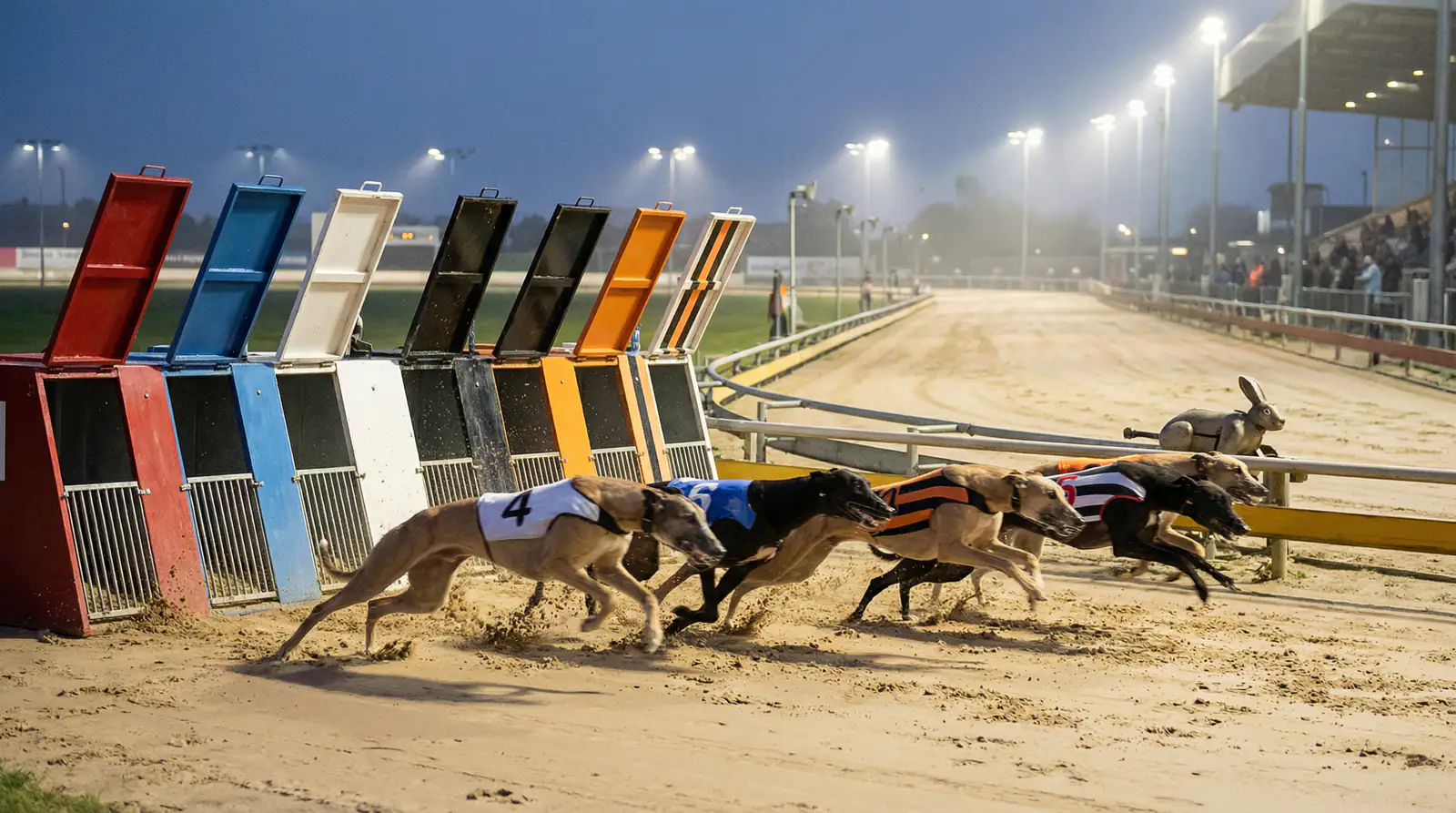
Pure Acceleration
At 275 metres there’s no room for error and no time to recover from a slow start. The sprint at Doncaster is the shortest race on the card — two bends, a burst from the traps, and it’s over in roughly 16 seconds. In that compressed window, break speed is everything. A dog that misses the lids by a fraction at 483 metres can make up ground through four bends. At 275 metres, the race is decided before most dogs have settled into their stride.
Sprint races at Doncaster attract a specific type of dog: the fast-twitch specialist built for explosive acceleration rather than sustained running. These dogs often struggle at standard distance, fading through the third and fourth bends, but over two bends they’re devastating. Reading sprint form requires different priorities than reading 483m form, and the betting market often fails to adjust for that difference.
This analysis covers the dynamics unique to Doncaster’s 275m trip — trap draw influence, the outsized importance of early pace, and the betting angles that sprints produce better than any other race type on the card.
Sprint Dynamics at Doncaster
The 275m race at Meadow Court covers two bends and two short straights. From the traps, the field runs the initial straight — the same 105-metre run-up that serves the standard-distance races (BettingOdds.com) — before hitting the first bend, clearing the second bend, and finishing down the home straight. The entire race plays out over a smaller portion of the track than any other distance, and the reduced running means fewer opportunities for positional changes.
The pace dynamics at this distance are straightforward: the dog that leads at the first bend almost always wins. Statistical analysis of sprint races across UK tracks consistently shows that the first-bend leader wins between 55 and 65 per cent of two-bend races, depending on the track. At Doncaster, where the 105-metre run-up gives some scope for sorting out positions, the figure is at the lower end of that range — but it still means the leader at the first turn wins the majority of sprints.
This dominance of early speed creates a self-reinforcing dynamic. Because leading at the first bend is so advantageous, dogs with fast sectional times — the measure of their speed to the first line — hold disproportionate value in sprint races. A dog with a 4.6-second sectional at 275m is a genuine threat from almost any trap. A dog with a 5.1-second sectional, no matter how good its overall form at other distances, is likely to be chasing shadows by the first bend.
Interference plays a different role in sprints than in standard-distance races. There are only two bends where trouble can occur, and the field is typically more spread out by the second bend because the early speed differences have already sorted the running order. Most interference at 275m happens at the first bend, and it’s often decisive — a bump at the first turn that costs half a length at standard distance can cost the race at sprint distance because there’s no time to recover.
Track conditions affect sprints differently as well. Fast ground amplifies the advantage of quick breakers because the surface rewards acceleration. Heavy or slow ground reduces the speed differential between fast and moderate breakers, making sprints slightly less predictable. Punters who adjust their sprint assessments for going conditions gain an edge over those who apply the same form reading regardless of surface speed.
Trap Draw at 275m
Sprint distance is where trap bias at Doncaster is most pronounced. Trap 1 produces a win rate significantly above the 16.7 per cent baseline expected from a six-dog race, and trap 6 underperforms by a comparable margin. The geometry is simple: two bends mean two opportunities for the shortest arc to deliver an advantage, and the dog on the rail runs the shortest arc both times.
Trap 2 is the second-best draw at 275m, benefiting from proximity to the rail without the risk of being squeezed against it by a crossing runner from outside. Traps 3 and 4 occupy a neutral zone where the draw is neither a help nor a hindrance in most races. Trap 5 is a mild disadvantage, and trap 6 is a significant one.
The exceptions follow predictable lines. A trap 6 dog with the fastest sectional in the field can overcome the wide draw if it breaks clear and crosses to the rail before the first bend — but that requires a decisive early-speed advantage over the inside dogs. If the trap 1 or trap 2 dog has a comparable sectional, the wide breaker’s crossing attempt becomes a collision risk rather than a racing move.
For betting purposes, the trap draw at 275m should carry more weight in your assessment than at any other Doncaster distance. A dog with decent form but a poor draw (trap 5 or 6) needs to offer a longer price to justify the risk. A dog with average form but trap 1 on a fast track is a live contender simply because the geometry works in its favour. Adjusting your assessment by one or two price points based on trap alone is not an overreaction at this distance — it’s the appropriate response to the data.
Early Pace and Break Speed
The single most predictive data point in a 275m race at Doncaster is not the form figure. It’s the sectional time — the measure of how quickly each dog reaches the first timing line from a standing start. If you rank the six dogs in a sprint by their most recent sectionals and back the fastest, you’ll have a profitable long-term approach at this distance, even without considering any other form factor.
That’s not to say form is irrelevant — a dog’s recent finishing positions, grade, and running comments all matter. But at 275m, the hierarchy of importance shifts. At standard distance, form figures, grade, and running style carry equal weight alongside sectionals and trap draw. At sprint distance, the pyramid tilts heavily toward break speed. A dog that consistently posts sectionals in the top two of its field is a contender. A dog that doesn’t is unlikely to lead, and a dog that doesn’t lead at 275m is unlikely to win.
Watch for trap-specific sectionals. A dog that posted a 4.65-second sectional from trap 1 may not replicate that speed from trap 5, where it has further to travel to the rail. When a sprint dog changes trap between runs, adjust your expectation of its sectional accordingly — a shift from inside to outside typically adds 0.05 to 0.10 seconds, which can move a dog from the front of the pace map to the middle.
Dogs returning from a break or switching from standard distance to sprint for the first time are wildcards. They may have the raw speed for the trip but lack the trapping sharpness that established sprinters develop through repetition. First-time sprinters at Doncaster are worth watching but not necessarily worth backing — wait for the sprint sectional before committing money.
Sprint Betting Angles
Sprints produce specific betting patterns that differ from standard-distance races. The short-priced favourite in a sprint is often the trap 1 or trap 2 dog with the fastest known sectional, and the market gets this right more frequently than at other distances. As a result, backing short-priced sprint favourites tends to produce a lower strike rate relative to their odds than backing comparable favourites at 483m.
The better angle is the reverse: opposing short-priced favourites when there’s a form-based reason to doubt the assumed pace advantage. If the favourite’s fast sectional was recorded on a fast track and today’s surface is heavy, the speed gap narrows. If the favourite’s recent SAw comments suggest a trapping issue, the fast sectional may not materialise. In these situations, the second-fastest sectional dog at a bigger price represents value.
Forecast betting in sprints can be more predictable than at standard distance because the two-dog nature of many sprint finishes — leader and challenger — reduces the number of realistic first-second combinations. If two dogs have clearly superior sectionals, a reverse forecast covering both orders offers a compact bet with reasonable payout potential.
The Shortest Race, The Sharpest Edge
Sprint races compress all the variables of greyhound racing into 16 seconds and two bends. The result is a race type where the data is cleaner, the key metric (break speed) is more identifiable, and the form analysis is more direct than at any other distance. That clarity is both the opportunity and the risk — it’s easier to identify the right dog, but the market is often already there ahead of you.
The edge in Doncaster sprints belongs to the punter who looks beyond the obvious. The fastest sectional from the best trap is usually the favourite. The value lies in the spots where the obvious favourite has a crack in its profile — a recent slow break, a trap change, a going shift — and a second or third dog in the field offers the right combination of speed and price to exploit that vulnerability. Short races demand sharp analysis, and the 275m at Doncaster rewards it.
