

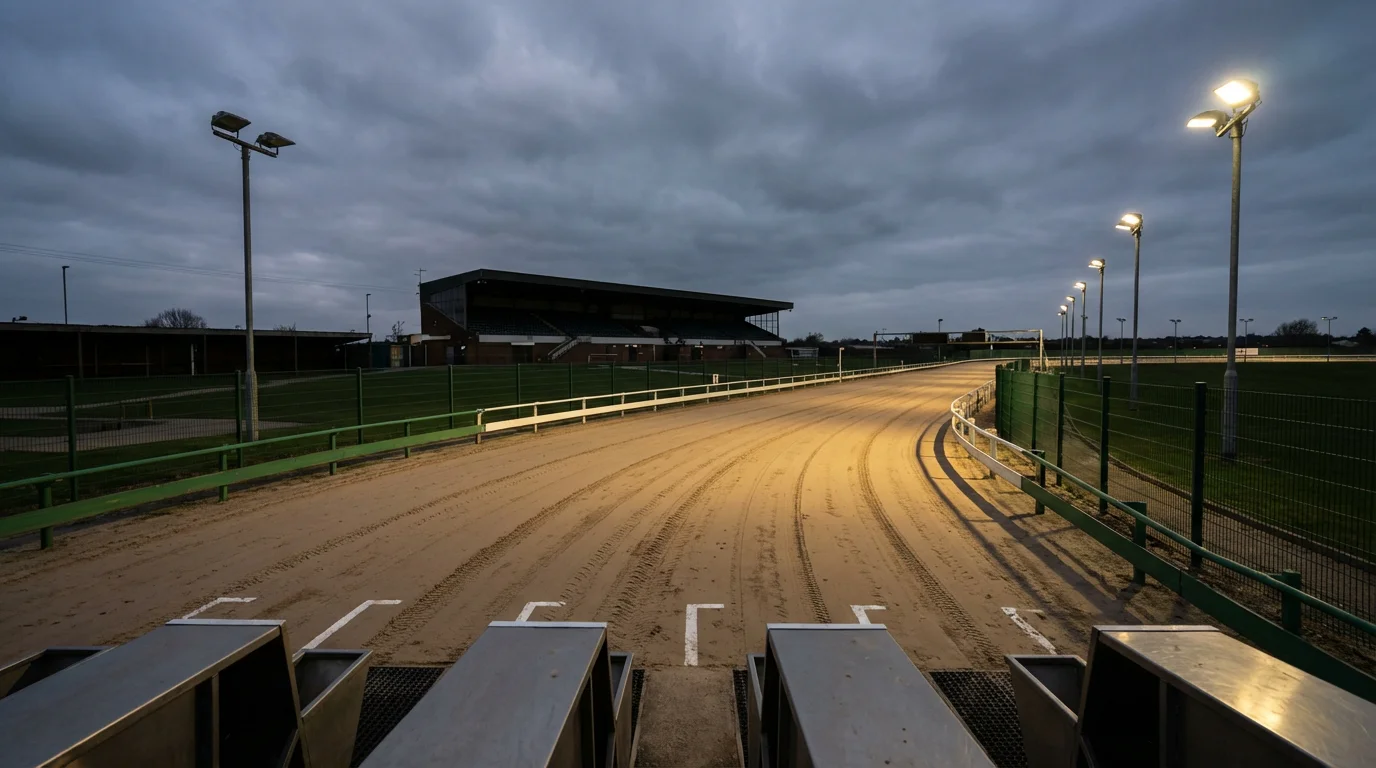
- What the Track Layout Tells You Before a Race Starts
- Track Dimensions and Configuration
- The 275m Sprint: Pure Acceleration
- The 483m Standard: Where Most Races Happen
- The 661m and 705m: Stayers Territory
- The Run to the First Bend: 105 Metres of Chaos
- Sand Surface and Weather Effects
- How Doncaster Compares to Other UK Tracks
- The Track Is the First Form Variable
What the Track Layout Tells You Before a Race Starts
Stand at the first bend of Meadow Court Stadium and the entire track logic reveals itself. The oval stretches out in both directions, the sand surface catches whatever light the South Yorkshire weather allows, and six starting boxes sit at measured intervals around the circuit depending on the race distance. Before a single dog breaks from the traps, the track has already shaped the outcome. Its dimensions, its surface, its bend angles — these are the constants that every greyhound result at Doncaster is filtered through.
Most punters skip the track analysis entirely. They read form, check odds, maybe glance at the trap draw, and move on. That approach works often enough at Doncaster’s standard distances, where the form book is deep and the patterns are well established. But it fails at the margins — the sprint races where half a length decides the dividend, the stayer events where track shape rewards a particular running style, the wet-weather meetings where times shift by half a second across the board. Understanding the track is what separates a punter who reacts to results from one who anticipates them.
This guide covers everything about Doncaster’s physical layout that affects racing outcomes. Dimensions, distances, the run to the first bend, surface behaviour, and how the whole package compares to other UK circuits. If you’re betting on Doncaster greyhounds with any regularity, this is the baseline knowledge that makes everything else — form, sectionals, trap statistics — actually useful.
Track Dimensions and Configuration
438 metres of oval, sand surface, inside hare — these aren’t trivia, they’re the rules of the game. Every result at Doncaster is produced within these physical parameters, and knowing them precisely is the foundation of track-aware betting.
Doncaster’s circumference of 438 metres places it in the mid-range of UK greyhound tracks. It’s not a tight circuit where the bends come fast and inside traps dominate almost every race. And it’s not a sweeping course like the former Wimbledon track was, where the wider turns favoured middle-running dogs with stamina. Doncaster sits in between — wide enough that outside traps aren’t automatically disadvantaged, but compact enough that the rail still matters over shorter distances.
The track runs four racing distances: 275 metres, 483 metres, 661 metres, and 705 metres. Each distance uses a different starting position around the oval, which means each distance presents a different challenge in terms of how many bends the dogs negotiate, how far they run before the first turn, and how the trap draw influences the outcome. The 275m sprint involves just two bends. The 483m standard takes dogs around four bends. The 661m and 705m stayer distances add further bends and a longer test of stamina.
The surface is sand — the standard for modern UK greyhound tracks. Sand provides a consistent running surface that drains reasonably well in wet weather, though it still varies in speed depending on moisture content and maintenance. Doncaster’s sand is maintained by the track groundstaff between meetings, and the going — fast, standard, or slow — is reported before each meeting begins. This going report is the equivalent of checking course conditions before a horse race, and it directly affects the times you should expect from any given dog.
The hare runs on the outside rail. Doncaster uses a Fannon/Swaffham-type mechanical hare on the outside Sumner rail, which is the standard configuration at the majority of modern UK tracks. Despite the hare’s outside positioning, inside trap positions still hold a structural advantage, particularly at shorter distances where the first bend arrives quickly and the rail-side line is the shortest route. At longer distances, the effect is diluted because there are more bends and more opportunities for dogs to find position regardless of their starting box.
The grandstand at Meadow Court accommodates roughly 1,500 spectators, though the effective capacity varies depending on whether the meeting includes hospitality bookings. For the purposes of track analysis, the grandstand position matters only in that it gives you a view of the first bend and the home straight — the two sections of the race where most positional changes occur and where the visual evidence confirms or contradicts what the form data predicted.
The 275m Sprint: Pure Acceleration
At 275 metres there’s no room for error and no time to recover from a slow start. The sprint at Doncaster is a two-bend dash where the outcome is often settled before the dogs reach the first turn. If you want to understand what makes sprint racing at this track distinctive, start with a single fact: the entire race lasts roughly sixteen seconds. In that window, a greyhound covers 275 metres, negotiates two bends, and either wins or doesn’t. There is no middle ground.
The trap draw is more influential at 275m than at any other Doncaster distance. Trap one, sitting on the inside rail with the shortest route to the first bend, consistently produces the highest win percentage in sprint races. The geometry is unforgiving — a dog breaking fast from trap one reaches the bend on the rail with nothing to its inside, and the dogs from wider traps have to either cut across or accept running a longer route around the outside. Over only two bends, that extra distance is rarely recovered.
The type of dog that wins 275m races at Doncaster is predictable in profile if not in identity. These are fast-break specialists — greyhounds with explosive early pace who leave the traps cleanly and reach racing speed within the first thirty metres. Stamina is almost irrelevant. What matters is reaction time from the boxes, acceleration over the first fifty metres, and the ability to hold position through two bends without losing ground.
Typical winning times at 275m depend on going conditions but generally fall between 15.80 and 16.40 seconds. Sub-16-second runs indicate a genuinely fast dog on a fast track. Anything above 16.50 suggests either slow going or a race with interference. When you’re comparing sprint form for Doncaster dogs, these benchmarks help you calibrate: a dog with a best of 15.90 is in the upper tier for this distance, while a dog whose times hover around 16.30 is competitive but not exceptional.
Betting on 275m races requires a different mindset from standard-distance form analysis. Form figures still matter, but the weight of your assessment should shift towards trap draw and early pace. A dog with mediocre recent form but a fast sectional and an inside draw is a stronger play at this distance than a consistent performer drawn in trap six. The sprint compresses everything — advantages and disadvantages alike — into so short a race that one variable can override all others.
The 483m Standard: Where Most Races Happen
The 483m is Doncaster’s bread and butter — the distance that generates most data and most betting turnover. On a typical meeting card at Meadow Court, the majority of races are run over this distance, which makes it the foundation of graded racing at the track. If you’re going to understand one distance thoroughly, this is the one.
Four bends, a full circuit of the track plus the straight run-in — that’s the geography of a 483m race. Dogs break from traps positioned near the start of the back straight, cover the run to the first bend, negotiate the turn onto the home straight, continue around the far turn, back down the second straight, through the final bend, and into the finish. The race lasts approximately 29 to 30 seconds at graded level, with the fastest A-grade dogs dipping below 29.20 on a fast track and lower-grade runners finishing in the 30-plus range.
What makes 483m the standard grading distance is its balance. Unlike the sprint, where trap draw and early pace dominate, the 483m rewards a broader range of running styles. Front-runners can lead and hold on if they break cleanly. Closers can sit behind the early pace and pick off tiring leaders through the final bend. Middle-running dogs with good bend technique can gain ground on every turn. This variety means that form assessment at 483m is richer and more nuanced than at any other Doncaster distance — there are more variables at play, more ways a race can unfold, and more data points to analyse.
The run to the first bend matters here, but differently from the sprint. Over 483m, the 105-metre run-up gives dogs enough time to find their stride and sort out early positioning without the desperate scramble that characterises the sprint. A dog that breaks a fraction slowly from trap three isn’t necessarily doomed — it has metres to recover before the bend arrives. This is why trap bias at 483m is less extreme than at 275m. Inside traps still hold a slight advantage in win percentage, but it’s nothing like the dominance trap one enjoys in sprints.
Pace maps are most useful at this distance. Because the race involves four bends and enough time for tactical positioning to develop, you can genuinely project how a race will unfold by comparing sectionals. If you identify one clear front-runner with a fast first split and no obvious rival for the lead, that dog has a strong chance of controlling the race from the front. If you see two or three fast sectionals drawn close together, the first bend becomes a contested zone — and the dog sitting just behind the pace, clean and unimpeded, often benefits most.
For form reliability, 483m is also the distance where you can trust the data most. Dogs race over it more frequently than any other distance at Doncaster, so the form book is deeper. A dog with six consecutive 483m runs gives you a meaningful sample. You can see how it handles different trap draws, different grades, different going conditions. You can compare its times across meetings and assess whether it’s improving, declining, or holding steady. At 275m or 661m, the sample size is often too thin for that level of analysis. At 483m, the data is there — and the punter who mines it properly has a genuine informational advantage.
One pattern worth noting: dogs moving from 275m sprints to 483m standard distance often struggle in their first few runs at the longer trip. The sprint develops a particular running style — all-out early pace with no need to sustain effort — that doesn’t translate directly to a race with four bends and a thirty-second duration. Watch for the first-time 483m runner whose sprint form looks strong. The market often prices these dogs on their sprint ability, but the step up in distance introduces an unknown that the odds don’t always reflect.
The 661m and 705m: Stayers Territory
Beyond 661 metres, the race becomes a question of stamina and heart, not just early speed. Stayer races at Doncaster are less frequent than 483m events, but they produce a different kind of contest — one where the form book needs to be read through a different lens entirely.
The 661m distance involves six bends and covers roughly one-and-a-half circuits of the track. Dogs break from a different starting position to the standard distance and face a longer race that tests their ability to maintain pace through multiple turns. The 705m adds another bend and another fifty-odd metres, making it the longest regularly raced distance at Meadow Court. Winning times at 661m typically fall between 40.50 and 42.00 seconds. At 705m, add another three to four seconds. These are long races by greyhound standards — almost double the sprint duration.
The dynamics shift fundamentally at these distances. Early pace still matters, because the run to the first bend is the same regardless of race distance and getting position before the first turn remains important. But a dog that leads at the first bend in a 661m race has five more bends to negotiate and another twenty-plus seconds of running ahead of it. If it doesn’t have genuine stamina, it will be caught. Front-running is harder to sustain, and the closers — dogs that sit behind the early pace and accelerate through the final two bends — become much more dangerous.
Wide runners gain an advantage at staying distances that they don’t have at shorter trips. At 483m, running wide adds distance that a dog can’t easily recover over four bends. At 661m and 705m, a wide-running dog has more bends and more straight to make up ground. The extra race distance forgives the wider route, especially if the dog is stronger in the final quarter of the race. This is why you’ll occasionally see a dog marked W on the card — a confirmed wide runner — that has poor 483m form but suddenly performs at 661m. The distance suits its style in a way that the shorter trip didn’t.
The stayer distances also produce more upsets than the standard distance. Partly because the form book is thinner — fewer races mean fewer data points per dog. Partly because stamina is harder to predict from numbers alone. A dog’s sprint sectional tells you how fast it is early, but it tells you very little about whether it can sustain effort over forty seconds of racing. And partly because the longer race simply allows more to happen. More bends means more opportunities for interference, more chances for a well-positioned dog to get crowded, and more scope for the pace to change in ways that suit a dog nobody expected.
For punters, the stayer races at Doncaster are a niche worth paying attention to precisely because they’re less analysed. The standard 483m races attract most of the betting volume and most of the form study. The 661m and 705m events often go under the radar, with less money in the market and less sophisticated pricing. If you’re willing to study the smaller dataset — comparing stayer form, identifying dogs with proven stamina, noting which runners handle the extra bends cleanly — there’s value to be found that doesn’t exist in the more competitive standard-distance markets.
The Run to the First Bend: 105 Metres of Chaos
105 metres — that’s all you get to sort out position, and most trouble happens in those first seconds. The distance from the starting traps to the first bend at Doncaster is one of the track’s defining characteristics, and it has a measurable effect on race outcomes across every distance.
To put it in context, 105 metres is relatively generous by UK greyhound track standards. Romford’s run to the first bend is approximately 67 metres. Nottingham sits around 85 metres. Doncaster’s extra distance gives dogs more time to accelerate, more space to find their racing position, and slightly more room to avoid the worst of the first-bend crowding that plagues tighter circuits. It doesn’t eliminate trouble — nothing does when six dogs converge on a single turn at thirty miles per hour — but it reduces the randomness factor compared to tracks where the bend arrives before the slower dogs have reached full speed.
The practical impact on race dynamics is significant. At tracks with a short run-up, inside traps dominate because the bend comes so quickly that outside dogs never have time to cross. At Doncaster, the 105-metre straight gives outside traps a fighting chance. A dog in trap five or six with genuine early pace can use the extra metres to push forward and get position before the bend arrives. This is why Doncaster’s trap bias, while still favouring the inside at shorter distances, is less extreme than at somewhere like Romford. The track geometry partially levels the field.
For form analysis, the first-bend run is where sectional times become relevant. A dog’s time to the first split point tells you how quickly it covers this crucial opening phase. Fast first-split times at Doncaster are especially meaningful because the longer run-up means the time genuinely reflects speed rather than simply reflecting which trap was closest to the bend. When two dogs post similar first-split times from different traps, you know they have comparable early pace — one just had further to travel.
The trouble that does occur at Doncaster’s first bend tends to follow predictable patterns. Dogs from the middle traps — three and four — are most vulnerable. They have runners on both sides and can get squeezed from either direction. If the dog in trap two drifts slightly wide and the dog in trap five pushes in slightly early, trap three is caught in the compression. Running comments that reference first-bend crowding — Crd1, Bmp1 — disproportionately involve dogs from the middle draws, and knowing this helps you assess whether a poor result was caused by the trap draw rather than a lack of ability.
Sand Surface and Weather Effects
Sand tracks play faster in dry weather and hold up differently to rain than the old grass straights ever did. The surface at Doncaster is sand-based, which is standard across modern UK greyhound tracks, and understanding how that surface behaves in different conditions is essential for accurate time comparison and form assessment.
In dry conditions, the sand at Meadow Court runs fast. The surface is firm, the dogs get good grip, and times tend to cluster at the quicker end of the expected range for each grade. A fast-going report before a meeting tells you to expect sharp sectionals and finishing times that sit below each dog’s average. Dogs with natural early pace tend to benefit most on a fast track because they can utilise their speed without the surface sapping their effort.
Rain changes the picture. A wet sand surface holds moisture, becomes heavier, and slows the going. Times across the entire meeting will drift upward — not dramatically, but measurably. A dog that runs 29.40 on a fast track might run 29.80 on a rain-affected surface over the same 483m distance. The critical point for punters is that this shift affects all dogs, not just specific ones. When comparing form from one meeting to another, you need to know the going on both occasions. A dog that ran 30.10 on a slow track last Wednesday and 29.90 on a standard track the previous Saturday has actually improved, even though the raw time got slower and then faster. Without the going context, you’d misread the trend.
Track maintenance also plays a role. The sand is raked and prepared between meetings and sometimes between races within a meeting. The surface early in an evening session can be different from the surface three hours later — slightly more churned up, with footmarks affecting the going line along the rail. This is a marginal factor, but it’s one that experienced Doncaster punters account for, particularly in later races on the card where the inside running line has seen more traffic.
Seasonal patterns matter too. Winter meetings in South Yorkshire often run on heavy going, with cold, damp air keeping the sand moist even without active rainfall. Summer meetings typically offer faster surfaces. If you’re comparing a dog’s autumn form to its spring form, be aware that the going difference alone can account for several lengths over 483m. Form figures that look like a decline might simply reflect the seasonal shift in track speed, and a dog that appears to improve dramatically in May might just be running on faster ground.
How Doncaster Compares to Other UK Tracks
Doncaster’s circumference slots it between the tighter northern tracks and the larger southern ovals, which makes it a useful reference point for understanding how dogs transfer between venues.
Romford, one of the busiest tracks in the UK, has a circumference of approximately 350 metres with a notably short run to the first bend of around 67 metres. Racing there is fast, tight, and heavily biased towards inside traps. Dogs that excel at Romford are typically sharp breakers with good bend technique on tight turns. When a Romford dog transfers to Doncaster, the wider circuit and longer run-up can be disorienting. The dog might not need the explosive first-bend speed it relied on at Romford, and the wider bends require a different stride pattern. Some adapt well; others never look as effective.
Nottingham operates on a circumference of around 437 metres, very close to Doncaster’s 438 metres. The run to the first bend is around 85 metres for the 500m distance, shorter than Doncaster’s, and the standard racing distance is 500 metres rather than 483. Dogs transferring from Nottingham to Doncaster face a smaller adjustment — the track shapes are broadly similar — but the distance difference means their 500m form doesn’t map directly onto 483m times. A Nottingham 500m time of 30.20 doesn’t translate to a Doncaster 483m equivalent without factoring in the different circuit, bend tightness, and surface.
Towcester, before its closure and subsequent periods of uncertainty, ran a 420-metre circumference circuit with sweeping bends and a notably long home straight. Dogs from Towcester-type tracks tend to be strong gallopers that handle open running. At Doncaster, they can look flat through the tighter turns, particularly in sprint and standard-distance races. However, Towcester stayers often transfer well to Doncaster’s 661m and 705m races, where the premium on stamina and sustained running matches the demands of the wider bends they trained on.
Sheffield, another northern track, runs at roughly 425 metres circumference with race distances that overlap with Doncaster’s programme. The proximity of the two tracks means trainers frequently enter dogs at both venues, and the form crossover is more reliable than with distant southern tracks. A dog running competitive A4 times at Sheffield is likely to race at a similar grade level at Doncaster, though minor adjustments for the different circumference and bend angles still apply.
The practical takeaway for Doncaster punters is straightforward: treat track-transfer form with caution, scaled by the degree of difference between the circuits. A dog moving from Sheffield is a small adjustment. A dog arriving from Romford is a larger unknown. A dog’s first run at Doncaster after racing exclusively elsewhere is always a provisional data point — respect the form, but don’t stake on it as heavily as you would on an established Doncaster runner with ten consecutive outings at Meadow Court.
The Track Is the First Form Variable
Before you read a single line of form, understand the track — because that’s the stage every result is performed on. Doncaster’s 438-metre oval, its four racing distances, its 105-metre run to the first bend, its sand surface and its mid-range configuration among UK tracks are not background details. They are the framework within which every time, every trap statistic, and every running comment acquires its meaning.
A dog’s 29.40 over 483m means something specific at Doncaster that it wouldn’t mean at Romford or Nottingham. A trap-one advantage in a 275m sprint is a function of this track’s geometry, not a universal law. A wet-weather time that looks slow might be entirely respectable once you factor in the going on a South Yorkshire January evening. Every number on a Doncaster result card is anchored to this particular circuit, and the punter who internalises the track’s characteristics reads those numbers more accurately than one who treats them as abstract figures.
The track is the constant variable. Dogs change fitness, trainers change routines, going changes with the weather, and grades shift with results. But the 438-metre circumference, the four bend configurations, the 105-metre run-up — those stay the same meeting after meeting, year after year. Learn them once, reference them always, and you have a baseline against which every piece of Doncaster form data can be measured with the precision it deserves.
In greyhound betting, the punters who profit long-term are invariably the ones who understand their tracks. Not in a vague, general sense, but in the specific, measurable detail that turns raw data into actionable insight. You’ve now got that detail for Doncaster. The next step is applying it every time you open a race card for Meadow Court Stadium — and noticing how much more the numbers tell you when you know the stage they were produced on.
