

What the Numbers Actually Mean
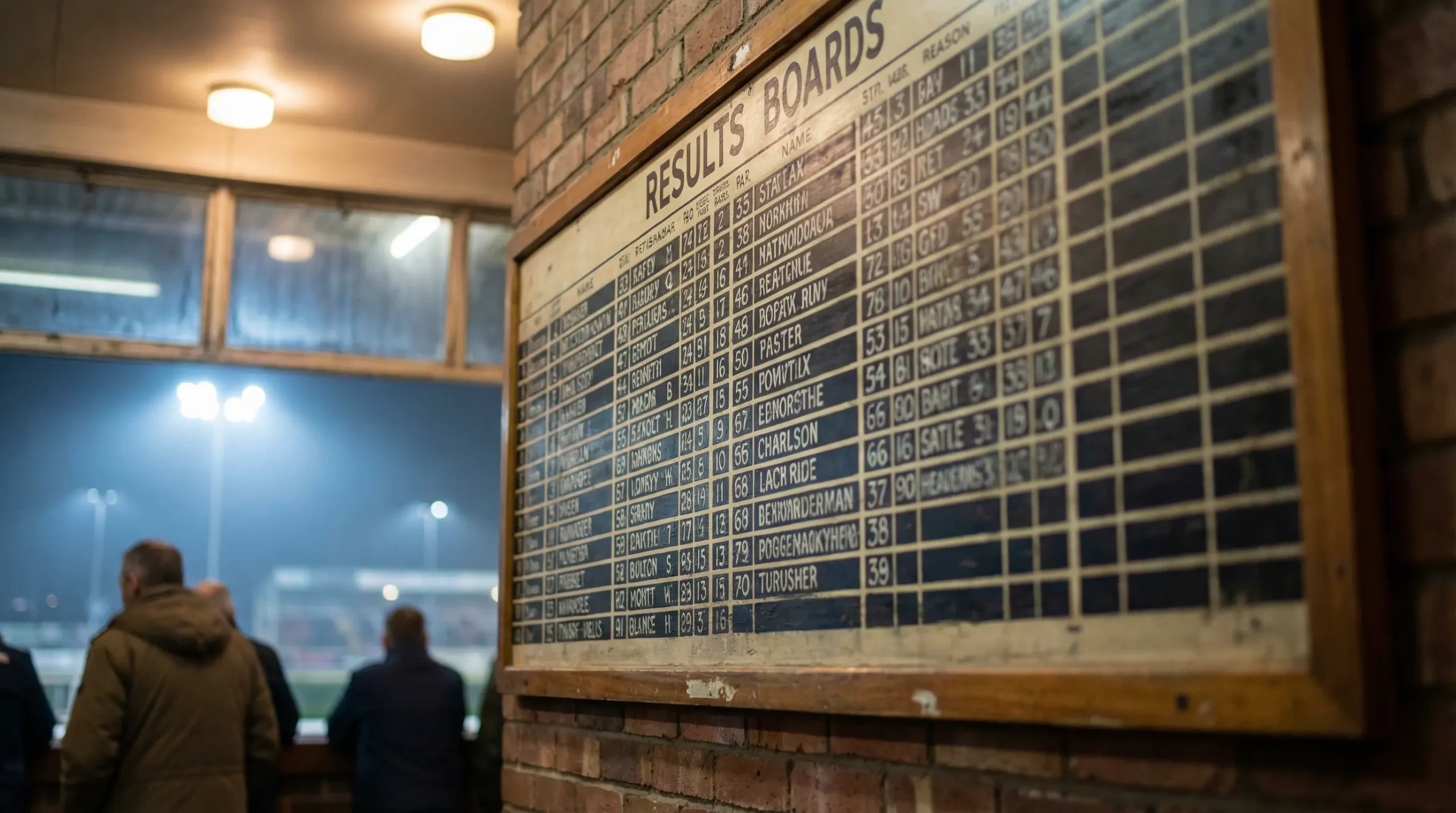
A Doncaster greyhound results page packs a dense amount of information into a compact format. Finishing positions, distances, times, prices, dividends — each column contains data that tells part of the story. The challenge for anyone new to the sport isn’t the data itself but the terminology that labels it. Once you know what each term refers to and how it’s calculated, the results page transforms from an opaque spreadsheet into a readable race narrative.
This guide works through the terminology column by column, covering race result data, betting-specific terms, distance measurements, and time-related figures. It’s designed as a reference — something to consult alongside the results page until the language becomes automatic.
Race Result Column Terminology
Trap — the starting box number, 1 through 6, corresponding to the dog’s position at the start. Trap 1 is closest to the inside rail; trap 6 is widest. Each trap has a standard jacket colour: red (1), blue (2), white (3), black (4), orange (5), and black-and-white stripes (6).
Dog Name — the registered name of the greyhound as recorded in the GBGB database. Names are unique within the register and follow naming conventions set by the governing body. The name is sometimes accompanied by the dog’s sex (d for dog, b for bitch) and colour abbreviation.
Trainer — the licensed trainer responsible for the dog’s preparation, kennelling, and race entries. The trainer name links to kennel statistics and provides context for the dog’s management and placement decisions.
Finishing Position — the order in which the dogs crossed the finish line. First through sixth, with first being the winner. In rare cases where a dog fails to complete the course, the position may be recorded as DNF (did not finish) or the equivalent notation used by the form provider.
Starting Price (SP) — the official odds at the moment the traps opened, as determined by the on-course market. SP is the default settlement price for bets taken at starting price and serves as the industry benchmark for assessing market accuracy. SP is expressed in fractional odds (3/1, 5/2, 11/4) in the UK market.
Betfair Starting Price (BSP) — the final matched price on the Betfair exchange at the point of the off. BSP is calculated algorithmically from the state of the exchange market and is expressed in decimal odds. BSP and SP can differ significantly, particularly on outsiders where the exchange price typically exceeds the bookmaker SP.
Weight — the dog’s body weight in kilograms as recorded at the pre-race weigh-in. Weight is listed to one decimal place and is a standard element of the race result. Changes in weight between races can indicate shifts in condition — a gain may suggest improving health or reducing fitness; a loss may suggest illness or sharpening for a race.
Grade — the competitive classification of the race. A1 through A11 for standard distance, S grades for stayers, D grades for sprints, OR for open races. The grade tells you the calibre of competition the dog faced and contextualises the finishing position — a third in an A2 race is a stronger performance than a third in an A8.
Running Comment — the race reader’s abbreviated description of the dog’s in-race experience. Comments like Led1 (led at bend one), Crd2 (crowded at bend two), and RnOn (ran on) compress the race narrative into shorthand. A full glossary of running comments is covered in the abbreviations guide, but their presence in the results provides immediate context for the finishing position.
Sectional Time — the time, in seconds, from the traps to the first timing point. This measures the dog’s break speed and early pace. Sectionals are published by detailed form providers like Timeform and are one of the most useful data points for pace analysis.
Betting-Specific Terms in Results
CSF (Computer Straight Forecast) — the calculated return for a one-unit straight forecast bet predicting the first two finishers in the correct order. The CSF is derived from the starting prices of the first and second dogs using a standard industry formula. It’s the default forecast settlement method for UK bookmakers.
CT (Computer Tricast) — the calculated return for a one-unit straight tricast bet predicting the first three finishers in the correct order. Like the CSF, the CT is calculated from the SPs of the placed dogs. Tricast dividends are inherently higher than forecast dividends because predicting three positions in order is more difficult than predicting two.
Forecast Dividend (FD) — the tote pool forecast dividend, representing the actual return per unit stake from the tote forecast pool. The FD reflects the pool’s composition — how much money was wagered and how it was distributed across the possible first-second combinations. The FD and CSF can differ substantially because they’re calculated from different sources (pool vs SP).
Tricast Dividend (TD) — the tote pool tricast dividend, functioning on the same pool-based principle as the FD but for the first three finishers in order.
Tote Win Dividend — the return per unit stake from the tote win pool. This figure tells you what the tote paid for a winning bet on the first-placed dog. Comparing the tote win dividend to the SP reveals whether the tote paid better or worse than the bookmaker market on that specific result.
Tote Place Dividend — the return per unit stake from the tote place pool for dogs finishing first or second. In six-dog greyhound races, the standard tote place terms are first and second. Each placed dog generates its own place dividend, which can differ — the tote might pay more for a place on an outsider than on the favourite.
Non-Runner (NR) — a dog withdrawn from the race before the off. Non-runners are marked on the results page, and bets placed on non-runners are typically voided (stake returned). Non-runners reduce the field size, which affects race dynamics and dividend calculations.
Distance Measurement Terms
The gaps between finishers are measured in lengths and fractions of a length. These distance terms appear in the results between each successive finisher, reading from first to second, second to third, and so on.
nse — a nose. The smallest measurable margin, indicating the dogs crossed the line almost simultaneously. A nose verdict means less than a quarter of a length separated the two finishers.
sh hd — a short head. Slightly more than a nose, this indicates about a quarter of a length. A photo finish may be required to separate dogs at this margin.
hd — a head. Approximately half a length. The first dog’s nose was ahead of the second dog’s head at the line.
nk — a neck. Roughly three-quarters of a length. A clear but not decisive margin.
1, 1½, 2, 2½ — lengths. One length is approximately the distance from a greyhound’s nose to the base of its tail. Distances above one length are expressed as whole numbers or halves. A three-length margin indicates clear superiority; a half-length indicates a tight finish.
dist — a distance. The official term for a margin exceeding 30 lengths. When a dog finishes so far behind the field that the gap is essentially unquantifiable in meaningful terms, it’s recorded as a distance. This usually indicates the dog stopped running, suffered a severe interference incident, or was completely outclassed.
These distances are visual estimates made by the judge at the finishing line, not electronic measurements. The precision is approximate — a margin recorded as “two lengths” might be anywhere from 1.5 to 2.5 lengths — but the terminology is standardised and consistent across all GBGB-licensed tracks.
Time and Speed Terminology
Winning Time — the raw time, in seconds to two decimal places, recorded for the first dog to cross the finish line. This is the headline time figure on the results page. At Doncaster over 483 metres, winning times typically range from approximately 29.00 seconds (fast going, high grade) to 30.50 seconds (slow going, lower grade).
Calculated Time — the adjusted time that accounts for the track variant (going adjustment) and sometimes weight. Published by Timeform and the Racing Post, calculated times normalise performances to a standard baseline, allowing meaningful comparison between runs recorded on different days under different conditions. A calculated time of 29.30 on a slow day represents a better performance than a raw time of 29.30 on a fast day.
Track Variant — the numerical adjustment applied to all times at a meeting to account for how fast or slow the track was running relative to the standard. A negative variant (e.g., -0.15) means the track was fast; a positive variant (e.g., +0.20) means it was slow. The variant is calculated by comparing actual race times against expected times based on the grades of the runners.
Going — the official description of the track surface conditions. Standard descriptors are fast, normal (or standard), and slow, sometimes with intermediate terms like fast-normal or normal-slow. The going is assessed before the meeting begins and may be updated if conditions change (for instance, if rain arrives). Going affects all times at the meeting and is the primary driver of the track variant.
Sectional Time — the time from the traps to the first timing line, measuring early pace. Distinct from the overall winning time, the sectional isolates the break and initial acceleration phase. Fast sectionals indicate a quick trapper; slow sectionals indicate either a poor break or a dog that builds speed gradually.
Run Rate — a metric used by some analysts that expresses average speed in metres per second across the race distance. Run rate strips out the distance variable and allows comparison between performances at different distances, though its practical application in betting is limited compared to calculated times and sectionals.
Speak the Language
The results page is a compressed record of everything that happened in a race: who won, by how much, at what price, in what time, and under what conditions. Every term on that page carries information, and every column adds a dimension to the narrative. Learning the terminology is the cost of entry to serious form analysis — and it’s a cost that pays for itself the first time you read a results page fluently and spot something the market missed. The language is precise for a reason. Learn it precisely.
